 प्लाईवुड ज्ञान · तकनीक · विशेषज्ञता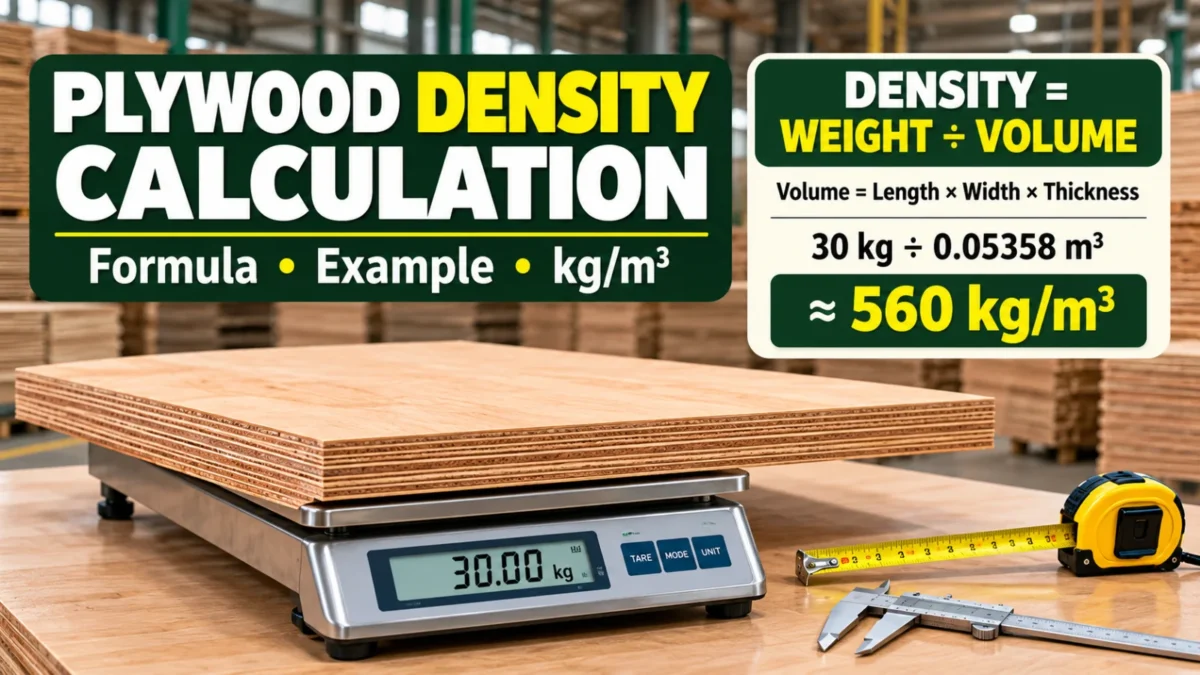
Plywood density is an important physical property used in plywood manufacturing, quality control, raw material evaluation, product development, and transportation planning. It helps manufacturers understand the relationship between panel weight and volume and compare plywood products of different thicknesses and constructions.
In this guide, you will learn how to calculate plywood density using a simple formula, practical examples, measurement methods, unit conversions, and an online calculation approach.
What Is Plywood Density?
Plywood density is the mass of a plywood panel divided by its volume. It is commonly expressed in kilograms per cubic metre (kg/m³) or grams per cubic centimetre (g/cm³).
Density depends on wood species, veneer composition, adhesive content, panel construction, moisture content, and manufacturing conditions. Therefore, plywood made from different species or manufactured under different conditions may have different density values.
Plywood Density Formula
The basic formula is:
Density (kg/m³) = Weight (kg) ÷ Volume (m³)
For a rectangular plywood sheet:
Volume (m³) = Length (m) × Width (m) × Thickness (m)
Therefore:
Plywood Density (kg/m³) = Weight (kg) ÷ [Length (m) × Width (m) × Thickness (m)]
Always use consistent units when calculating density.
How to Calculate Plywood Density: Practical Example
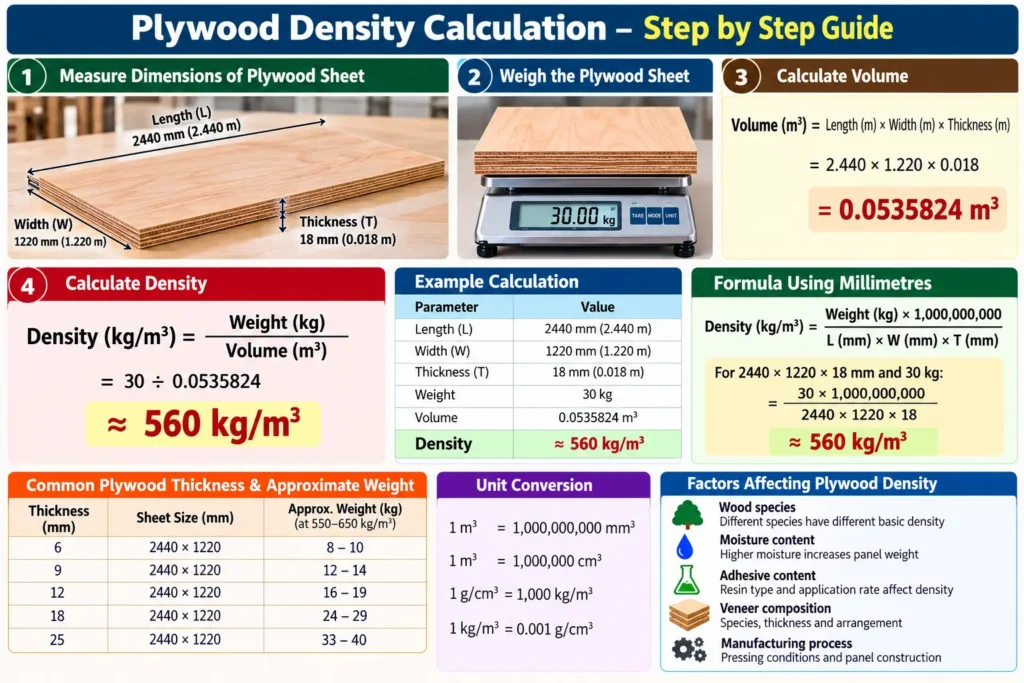
Suppose a plywood sheet has the following dimensions and weight:
- Length: 2440 mm
- Width: 1220 mm
- Thickness: 18 mm
- Weight: 30 kg
Step 1: Convert dimensions into metres
Length = 2.440 m
Width = 1.220 m
Thickness = 0.018 m
Step 2: Calculate volume
Volume = 2.440 × 1.220 × 0.018
Volume = 0.0535824 m³
Step 3: Calculate density
Density = 30 ÷ 0.0535824
Plywood Density = approximately 560 kg/m³
This is an illustrative calculation, not a specification for every 18 mm plywood panel.
Plywood Density Formula Using Millimetres
In plywood factories, dimensions are often recorded in millimetres and weight in kilograms.
For these units, use:
Density (kg/m³) = [Weight (kg) × 1,000,000,000] ÷ [Length (mm) × Width (mm) × Thickness (mm)]
For a sheet measuring 2440 × 1220 × 18 mm and weighing 30 kg:
Density = (30 × 1,000,000,000) ÷ (2440 × 1220 × 18)
Density = approximately 560 kg/m³
This formula is convenient for production reports, laboratory records, and spreadsheet calculations.
Online Plywood Density Calculator
Enter plywood sheet details
Formula
Plywood density
Factors Affecting Plywood Density
Wood species
Different wood species have different basic densities. Species selection and veneer composition influence the overall density of a plywood panel.
Moisture content
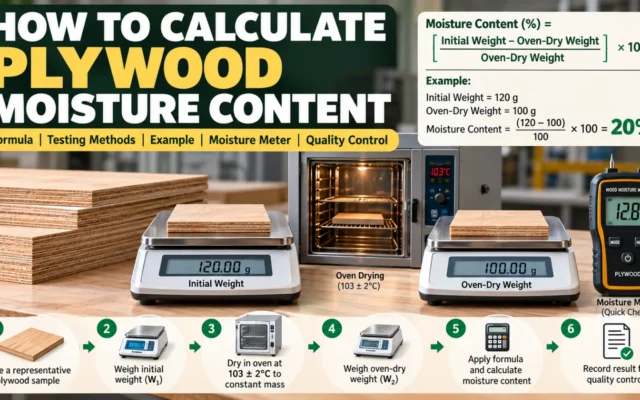
Water contributes to measured mass. Consequently, a plywood panel measured at a higher moisture content may show a higher apparent density than the same panel at a lower moisture content.
For meaningful comparisons, record the moisture content and follow the measurement conditions required by the applicable specification.
Adhesive and resin content
Adhesive contributes to the mass of the finished panel. Resin type, application rate, and retained adhesive content may therefore affect measured density.
Panel thickness
Thickness affects volume and can also influence the construction of the panel. Use measured thickness rather than relying only on the nominal thickness printed on the product.
Veneer composition
The species, thickness, moisture condition, and arrangement of individual veneers influence the physical properties of the finished panel.
Manufacturing process
Pressing conditions, adhesive application, panel construction, and finishing operations can affect final panel dimensions and mass.
Why Is Plywood Density Important?
Plywood density measurements are useful for:
- Quality-control comparisons between production batches.
- Estimating sheet weight for handling and transportation.
- Evaluating raw material and veneer composition.
- Comparing panel products when thickness, moisture, and test conditions are considered.
- Supporting production planning and material calculations.
- Investigating deviations in finished-panel weight.
Density alone does not establish plywood strength, bonding quality, durability, or compliance with a product standard. Those properties require their respective tests.
Common Mistakes in Plywood Density Calculation
- Mixing millimetres with metres without converting units.
- Using nominal thickness instead of measured thickness when greater accuracy is required.
- Recording sheet weight incorrectly.
- Comparing panels at different moisture conditions without noting the difference.
- Assuming that higher density automatically means better plywood quality.
- Ignoring panel irregularities or dimensional variations.
- Treating a simple sheet calculation as a substitute for the prescribed laboratory test.
Explore more plywood manufacturing guides, technical calculators, testing methods, and wood-panel industry resources on Plywood Guru.
Join the discussion