 प्लाईवुड ज्ञान · तकनीक · विशेषज्ञता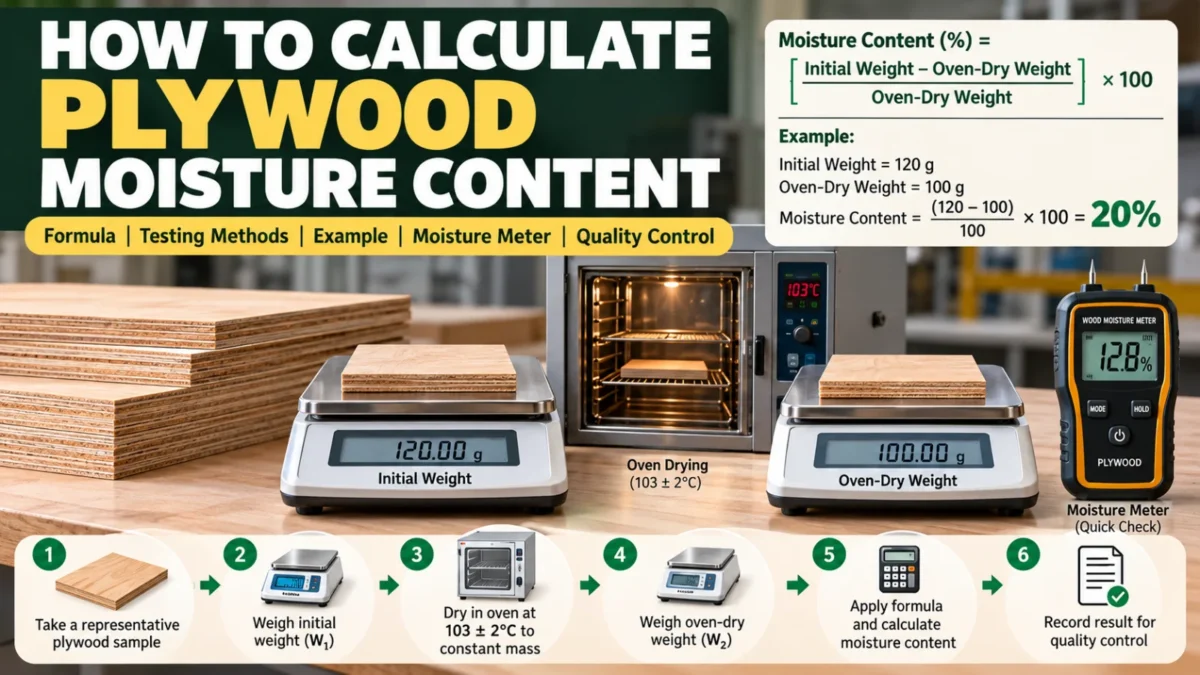
Moisture Content Formula, Testing Methods, Moisture Meter & Quality Control Guide
Plywood moisture content is one of the most important parameters in plywood quality control. It affects dimensional stability, bonding performance, machining, sanding, finishing, storage, and the long-term performance of plywood panels.
Whether you are a plywood manufacturer, production manager, quality-control engineer, furniture manufacturer, or home buyer, understanding how to calculate plywood moisture content helps you evaluate panel quality and identify potential moisture-related problems.
In this detailed guide, we explain the plywood moisture content formula, oven-dry testing method, moisture meter method, practical calculation examples, acceptable moisture content considerations, common testing mistakes, and frequently asked questions.
What Is Plywood Moisture Content?
Plywood moisture content (MC) is the percentage of water present in a plywood specimen relative to the oven-dry mass of that specimen.
Plywood contains wood veneers bonded together with adhesive. The wood absorbs and releases moisture depending on temperature, relative humidity, storage conditions, and exposure to water.
Moisture content is normally expressed as a percentage (%) and calculated on an oven-dry basis.
Example: If a plywood specimen weighs 120 grams before oven drying and 100 grams after oven drying, the moisture content is 20%.
Plywood Moisture Content Formula
The standard oven-dry-basis formula is:
Moisture Content (%) = [(Initial Weight − Oven-Dry Weight) ÷ Oven-Dry Weight] × 100
Where:
- Initial Weight = Weight of the specimen before oven drying.
- Oven-Dry Weight = Weight of the specimen after drying to the required constant-mass endpoint.
Practical calculation example
Suppose a plywood specimen has the following weights:
| Parameter | Weight |
|---|---|
| Initial specimen weight | 120 g |
| Oven-dry specimen weight | 100 g |
| Weight of moisture removed | 20 g |
Calculation:
Moisture content = [(120 − 100) ÷ 100] × 100
Moisture Content = 20%
Therefore, the plywood specimen has a calculated moisture content of 20% on an oven-dry basis.
Important difference: moisture percentage versus weight loss percentage
In this example, the weight loss is 16.67% of the original weight, but the moisture content is 20% on an oven-dry basis.
These values are different because the denominators are different. For standard wood moisture-content calculations, use the oven-dry weight in the denominator.
Calculate Plywood Moisture Content Online
Use this simple calculator to calculate moisture content from your laboratory weighing data.
Enter sample weights
Formula
Moisture content
Note: This calculator is for oven-dry-basis calculations. Use actual laboratory measurements and the applicable test standard for official quality-control results.
How to Test Plywood Moisture Content Using the Oven-Dry Method
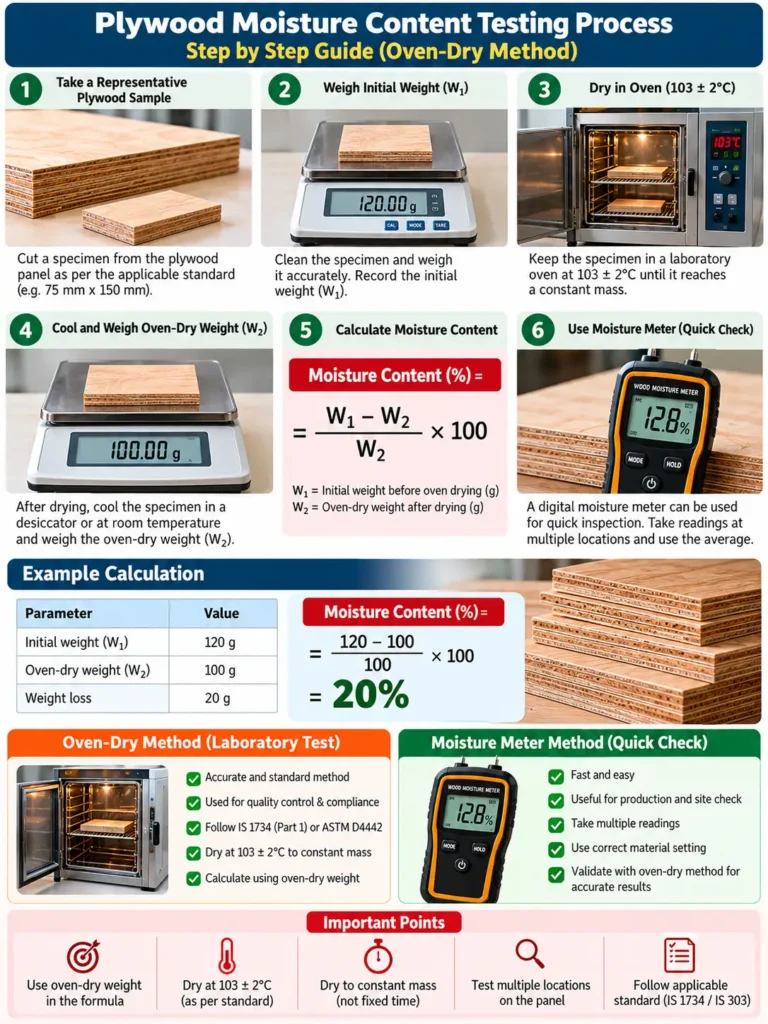
The oven-dry method is used to determine moisture content by weighing a specimen before and after drying. ASTM D4442 covers direct moisture-content measurement of wood and wood-based materials, including veneer and materials containing adhesives. In India, IS 1734 (Part 1) is the relevant plywood test-method reference for density and moisture content. https://store.astm.org/d4442-20r25.html
Equipment required
- Laboratory oven capable of maintaining the specified temperature.
- Weighing balance with suitable resolution.
- Specimen-cutting equipment.
- Heat-resistant gloves and a suitable cooling arrangement.
- Sample identification labels and a laboratory record sheet.
Step-by-step testing procedure
Step 1: Collect a representative plywood sample
Select a specimen from the plywood panel or production lot according to the applicable sampling procedure. Identify its thickness, grade, batch number, production date, and sampling location.
Step 2: Prepare the specimen
Cut a specimen of the required dimensions and full panel thickness. The historical IS 1734 (Part 1) method describes a specimen 75 mm wide and 150 mm long, with smaller specimens permitted when necessary. Confirm the currently applicable standard before conducting compliance testing. https://www.scribd.com/document/795094657/1734-1TO20
Step 3: Weigh the initial specimen
Record the initial weight accurately. For example:
Initial weight = 120.00 g.
Step 4: Place the specimen in the oven
Use the temperature and procedure specified by the applicable test method. The cited IS 1734 (Part 1) method specifies an oven temperature of 103 ± 2°C.
Step 5: Dry the specimen to constant mass
Dry the specimen until it meets the constant-mass criterion required by the applicable method. Do not assume that a fixed number of hours is sufficient for every specimen.
Step 6: Cool and weigh
Cool the specimen under the conditions required by the test procedure and record its oven-dry weight. Avoid allowing the dried specimen to reabsorb moisture before weighing.
Example:
Oven-dry weight = 100.00 g.
Step 7: Calculate moisture content
Moisture content = [(120 − 100) ÷ 100] × 100 = 20%.
Step 8: Record the result
Document the specimen identification, initial weight, oven-dry weight, calculated moisture content, test method, date, and operator.
Laboratory calculation table
| Parameter | Example reading |
|---|---|
| Sample ID | PLY-001 |
| Initial weight | 120.00 g |
| Oven-dry weight | 100.00 g |
| Weight loss | 20.00 g |
| Moisture content | 20.00% |
The figures above are illustrative and are not a claim about the actual moisture content of a particular plywood grade.
How to Measure Plywood Moisture Content Using a Moisture Meter
A digital wood moisture meter is useful for quick inspection in plywood factories, warehouses, furniture workshops, and installation sites.
Procedure
- Select a meter designed for the material and measurement purpose.
- Check whether the instrument supports plywood or wood-based panels.
- Enter the appropriate species or material correction if the manufacturer requires it.
- Follow the specified temperature-compensation procedure.
- Take readings at several representative locations on the panel.
- Record individual readings and the average, while retaining unusually high readings for investigation.
Pin-type versus pinless moisture meters
| Feature | Pin-type meter | Pinless meter |
|---|---|---|
| Measurement method | Electrical resistance between pins | Electromagnetic or dielectric response |
| Surface impact | Leaves small holes | Usually non-invasive |
| Measurement depth | Depends on pin length and design | Depends on instrument design |
| Main limitation | Readings affected by material composition and electrical conductivity | Readings affected by density, thickness, surface conditions, and calibration |
| Best use | Local spot measurements | Rapid scanning of panel surfaces |
Important: A meter calibrated for solid timber may not provide an accurate absolute moisture reading on plywood. Adhesive, veneer species, panel density, temperature, thickness, and moisture distribution can affect the result. Validate meter readings against an appropriate reference method before using them for formal acceptance decisions.
What Is the Acceptable Moisture Content of Plywood?
There is no single moisture-content percentage that should automatically be applied to every plywood product, application, and test method.
The acceptable value must be established using the relevant product specification, current standard, manufacturer requirements, and intended service conditions.
For Indian plywood, relevant standards include:
- IS 303:2024 — Plywood for General Purposes — Specification, fourth revision. https://www.bis.gov.in/is-303-2024
- IS 710 — Marine Plywood, where applicable to the product being evaluated.
- IS 1734 (Part 1) — Plywood test method for density and moisture content.
For compliance testing, refer to the current applicable standard and its specified test procedure rather than relying on an informal online moisture range.
Why moisture content must be evaluated carefully
- Excessive moisture can contribute to dimensional changes and finishing problems.
- Uneven moisture distribution may create different dimensional responses within a panel.
- Very dry panels can absorb moisture after storage or installation in a more humid environment.
- A moisture reading alone does not establish adhesive bond quality, water resistance, or plywood grade.
A moisture-content result should therefore be evaluated alongside the relevant dimensional, bonding, and other quality requirements.
Factors Affecting Plywood Moisture Content
Veneer moisture content
The moisture content of individual veneers before assembly and pressing can affect manufacturing behaviour and the finished panel.
Ambient relative humidity
Plywood exchanges moisture with the surrounding air. High humidity generally encourages moisture absorption, while dry conditions can encourage moisture loss.
Storage conditions
Direct water exposure, damp floors, unprotected edges, poor ventilation, and inadequate storage practices can create moisture-related problems.
Adhesive system
Adhesive formulation and the presence of other non-wood constituents can influence oven-dry measurements and electrical moisture-meter readings. Follow the applicable test method when evaluating bonded panels.
Panel thickness and construction
Different veneer layers, thicknesses, and construction arrangements may influence moisture distribution and the response of a moisture meter.
Testing method
Oven-dry measurements and moisture-meter estimates are not automatically equivalent. Use a consistent method for quality-control trending.
Common Mistakes When Calculating Plywood Moisture Content
Avoid these common errors during laboratory and factory quality checks.
- Using initial weight in the denominator: Standard oven-dry-basis moisture content uses oven-dry weight.
- Stopping oven drying too early: The result may be inaccurate if the specimen has not reached the required endpoint.
- Allowing moisture reabsorption: Improper cooling or delayed weighing can change the recorded dry mass.
- Testing only one location: A single reading may not represent the full panel or production lot.
- Ignoring meter calibration: Incorrect material settings can distort readings.
- Treating moisture content as a waterproofing test: Moisture content does not prove that a panel meets MR, BWR, BWP, or marine-plywood performance requirements.
- Using an assumed acceptable range: The applicable product standard and specification should determine the acceptance limit.
Plywood Moisture Content Quality-Control Checklist
Use this checklist for routine laboratory or production-floor checks.

Sources and technical references
- ASTM International — ASTM D4442, Standard Test Methods for Direct Moisture Content Measurement of Wood and Wood-Based Materials: https://store.astm.org/d4442-20r25.html
- Bureau of Indian Standards — IS 303:2024, Plywood for General Purposes — Specification: https://www.bis.gov.in/is-303-2024/
- Bureau of Indian Standards — IS 303 testing and laboratory information: https://lims.bis.gov.in/home/search_is_number/?is_number__doc_no=303
- IS 1734 (Part 1), Methods of Test for Plywood — Determination of Density and Moisture Content: verify the current official edition before using it for compliance testing.

Join the discussion