 प्लाईवुड ज्ञान · तकनीक · विशेषज्ञता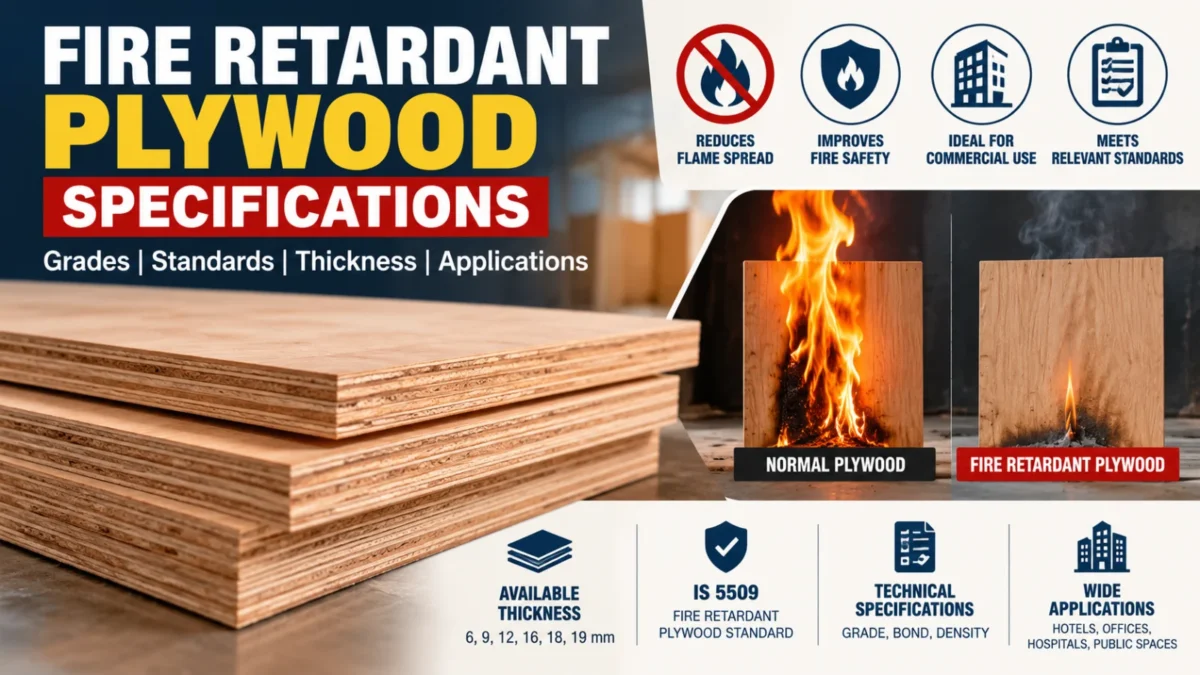
Fire retardant plywood is a specially treated plywood product designed to reduce flame spread and improve fire performance compared with conventional untreated plywood. It is used in commercial buildings, hotels, offices, hospitals, public spaces, and other projects where fire safety requirements influence material selection.
However, fire-retardant plywood is not fireproof. Its performance depends on the plywood construction, fire-retardant chemicals, manufacturing process, thickness, installation method, and results of the relevant fire tests.
In this guide, we explain fire-retardant plywood specifications, commonly used standards, treatment methods, technical properties, applications, and the important checks buyers should make before purchasing.
What Is Fire Retardant Plywood?
Fire retardant plywood is manufactured by treating suitable plywood veneers or finished plywood panels with approved fire-retardant chemicals. These chemicals are intended to slow flame propagation and reduce the contribution of the plywood to fire growth under specified test conditions.
Depending on the manufacturing process, treatment may be applied to veneers before bonding or to the assembled plywood panel. The treatment method must be compatible with the adhesive system and the required mechanical properties.
Fire-retardant plywood is commonly specified for interior applications where the building design requires materials with tested fire-performance characteristics.
Fire Retardant Plywood Specifications
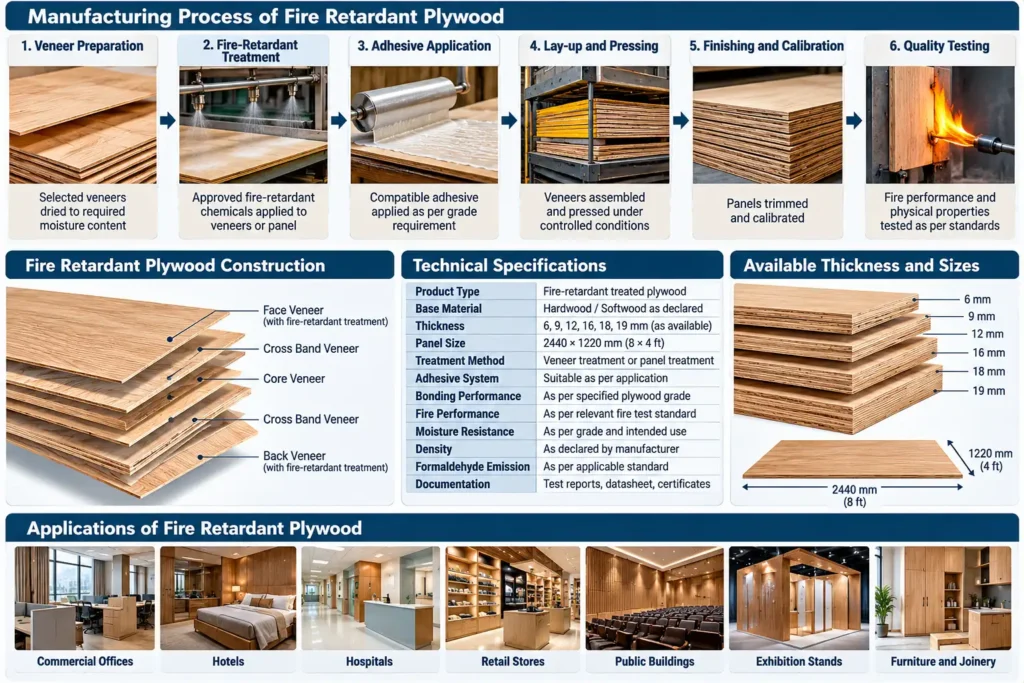
The exact specifications vary by manufacturer, product grade, thickness, intended application, and applicable fire regulations. The following table provides a practical checklist for evaluating a product rather than a universal specification for every fire-retardant plywood panel.
| Specification | What to Check |
|---|---|
| Product type | Fire-retardant-treated plywood |
| Base material | Hardwood, softwood, or other declared veneer species |
| Thickness | As required by the design, such as 6, 9, 12, 16, 18 or 19 mm, subject to product availability |
| Panel dimensions | Common formats include 2440 × 1220 mm and 8 × 4 ft, subject to manufacturer availability |
| Fire performance | Flame-spread, reaction-to-fire or other classification established by the applicable test |
| Treatment method | Veneer treatment or panel treatment, as declared by the manufacturer |
| Adhesive system | Suitable for the intended application and treatment process |
| Bonding performance | Tested bond quality appropriate to the specified plywood grade |
| Moisture resistance | Based on the declared grade and intended exposure conditions |
| Density and strength | Manufacturer-declared values or test results where required |
| Formaldehyde emissions | Compliance with applicable project and regulatory requirements |
| Documentation | Test reports, product datasheet, batch traceability and certificates where applicable |
Important: A thickness such as 12 mm or 18 mm does not automatically establish a fire rating. The declared fire classification must apply to the specific product and relevant end-use conditions.
Fire Retardant Plywood vs Fire Resistant Plywood
These terms are often used interchangeably in the market, but they should not be treated as equivalent without checking the test evidence.
- Fire-retardant plywood: Treated or formulated to improve specific fire-performance characteristics, such as reducing flame spread.
- Fire-resistant construction: A building element or assembly that meets a specified fire-resistance period under a relevant test. This may depend on the complete wall, ceiling, door or other assembly, not just the plywood panel.
- Fireproof plywood: An absolute claim that should generally be avoided because plywood is a combustible material and no treatment makes it universally immune to fire.
When selecting plywood for a project, always confirm which fire-performance property the specification actually requires.
Fire Retardant Plywood Standards in India
In India, plywood selection and fire safety compliance should be evaluated against the applicable Bureau of Indian Standards (BIS) publications, National Building Code provisions, local building regulations, and project specifications.
The following references may be relevant, depending on the application:
IS 5509 — Fire Retardant Plywood
IS 5509 is an important Indian Standard associated with fire-retardant plywood. Buyers should verify the current applicable edition, amendments, scope, product requirements, and certification status directly with BIS before using it as a procurement requirement.
A supplier’s claim of compliance should be supported by documentation applicable to the specific product being purchased.
National Building Code of India
The National Building Code of India contains provisions relevant to fire and life safety in buildings. Requirements depend on factors such as occupancy, building height, location, and the construction element involved.
The project consultant or fire-safety professional should determine which provisions and classifications apply to the intended installation.
Fire Test Standards and Classification
Depending on the project and jurisdiction, fire performance may be evaluated through tests covering flame spread, heat release, smoke production, or reaction to fire. Fire-resistance testing of an entire construction assembly is a separate matter.
A report should identify the test method, tested specimen, thickness, mounting conditions, classification criteria, and limitations of the result.
How Is Fire Retardant Plywood Manufactured?
The manufacturing process generally includes the following stages:
- Veneer preparation: Veneers are selected and dried to the moisture requirements of the manufacturing process.
- Fire-retardant treatment: An appropriate chemical formulation is applied using a validated treatment method.
- Treatment control: Chemical uptake, penetration, moisture changes and other critical process variables are monitored.
- Adhesive application: A compatible adhesive is applied to the veneers.
- Lay-up and pressing: Veneers are assembled in the required grain orientation and bonded under controlled pressing conditions.
- Finishing: Panels are trimmed, calibrated and inspected.
- Quality testing: Fire performance and relevant physical and mechanical properties are verified through the specified tests and quality-control procedures.
Not every manufacturer follows the same treatment sequence. Some processes treat veneers before bonding, while others treat finished panels. The suitability of either method must be established for the specific product.
Important Technical Properties
Fire performance
The primary requirement is the fire-performance classification demanded by the project. Do not assume that a chemical treatment or a supplier’s description alone proves compliance.
Bonding strength
Fire-retardant chemicals can affect adhesive bonding if the formulation and manufacturing process are not properly controlled. Bond quality should be verified against the applicable product specification.
Moisture resistance
Fire-retardant treatment does not automatically make plywood waterproof or suitable for exterior exposure. Select the appropriate plywood grade and verify the manufacturer’s declared exposure limitations.
Dimensional stability
Chemical treatment may change the moisture behaviour of veneers or panels. Proper conditioning, adhesive selection, pressing and quality control are important for maintaining dimensional stability.
Smoke and other fire characteristics
A flame-spread result does not necessarily establish smoke performance, heat release, toxicity or fire resistance. Confirm each property separately if the project specification requires it.
Applications of Fire Retardant Plywood
Fire-retardant plywood may be specified for:
- Commercial office interiors and partitions
- Hotel interiors and selected fit-out applications
- Retail stores and shopping centres
- Exhibition stands and display systems
- Wall and ceiling linings where permitted by the fire strategy
- Public buildings and institutional interiors
- Selected furniture and joinery applications in regulated environments
The product must be suitable for the specific application. A panel approved for one interior use should not automatically be assumed suitable for a different wall, ceiling, door or structural assembly.
How to Select the Right Fire Retardant Plywood
Before placing an order, verify the following:
- Confirm the fire classification required by the architect, consultant or local authority.
- Check the applicable Indian Standard or other specified test standard and its current edition.
- Obtain the manufacturer’s technical datasheet and relevant fire-test report.
- Confirm the approved thickness, panel dimensions and permitted end use.
- Check the plywood grade, bonding performance, moisture limitations and mechanical properties.
- Verify any required BIS licence or product certification and its scope through official BIS records.
- Confirm that the supplied batch and proposed installation conditions are covered by the documentation.
Avoid selecting a product solely because it is described as fire-retardant or because its price is lower than that of competing products.


Join the discussion