 प्लाईवुड ज्ञान · तकनीक · विशेषज्ञता
Buying plywood for your home, furniture, kitchen, or office may seem simple, but choosing the wrong type can lead to problems such as swelling, delamination, bending, poor screw-holding strength, and unnecessary repair costs. With so many plywood grades, thicknesses, and price ranges available in India, buyers often focus only on appearance and price instead of checking quality and suitability.
Whether you are buying plywood for a modular kitchen, wardrobe, bed, sofa, or commercial interior, understanding the common mistakes to avoid before buying plywood can help you make a better purchasing decision.
In this guide, we explain the most common plywood buying mistakes, how to identify quality plywood, which thickness to choose, and what to check before making a purchase.
Choosing Plywood Based Only on Price
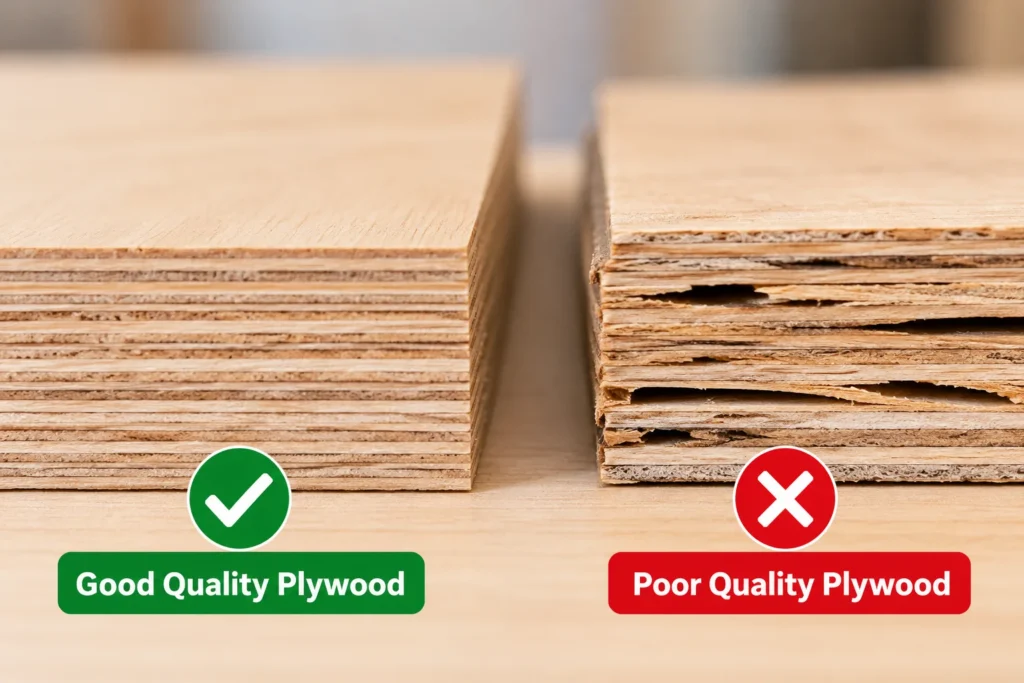
One of the most common mistakes when buying plywood is selecting the cheapest available option without checking its quality, grade, or intended application.
Low-priced plywood may be suitable for certain non-critical applications, but it may not provide the durability required for furniture exposed to moisture, frequent use, or heavy loads.
Before comparing prices, check:
- Plywood grade and intended application.
- Core quality and veneer construction.
- Bonding quality and resistance to delamination.
- Actual thickness and dimensional consistency.
- Manufacturer warranty and product documentation.
Buying tip: Compare plywood products with the same grade, thickness, dimensions, and intended use. A lower price does not necessarily mean a lower-quality product, and a higher price alone does not guarantee better performance.
Ignoring the Difference Between MR, BWR, and BWP Plywood
Not all plywood is designed for the same environment. Choosing the wrong grade can result in premature deterioration, especially in areas exposed to moisture.
MR Plywood
MR stands for Moisture Resistant. MR-grade plywood is generally used for interior furniture in relatively dry conditions, such as wardrobes, bookshelves, and bedroom furniture.
It should not be treated as waterproof plywood.
BWR Plywood
BWR stands for Boiling Water Resistant. It is intended for applications requiring greater resistance to water exposure than standard MR plywood. The exact suitability depends on the product specification and applicable standard.
BWP Plywood
BWP stands for Boiling Water Proof in common Indian market terminology. It is often selected for demanding applications, including kitchen furniture, where moisture resistance is important.
Always verify the product’s applicable Indian Standard, certification, and manufacturer specifications instead of relying only on the grade printed on the label.
Buying tip: For kitchen cabinets, bathroom-adjacent furniture, or areas with potential water exposure, select a suitable grade based on the actual moisture conditions. Even moisture-resistant plywood needs appropriate edge sealing, waterproofing details, and installation.
Buying the Wrong Plywood Thickness
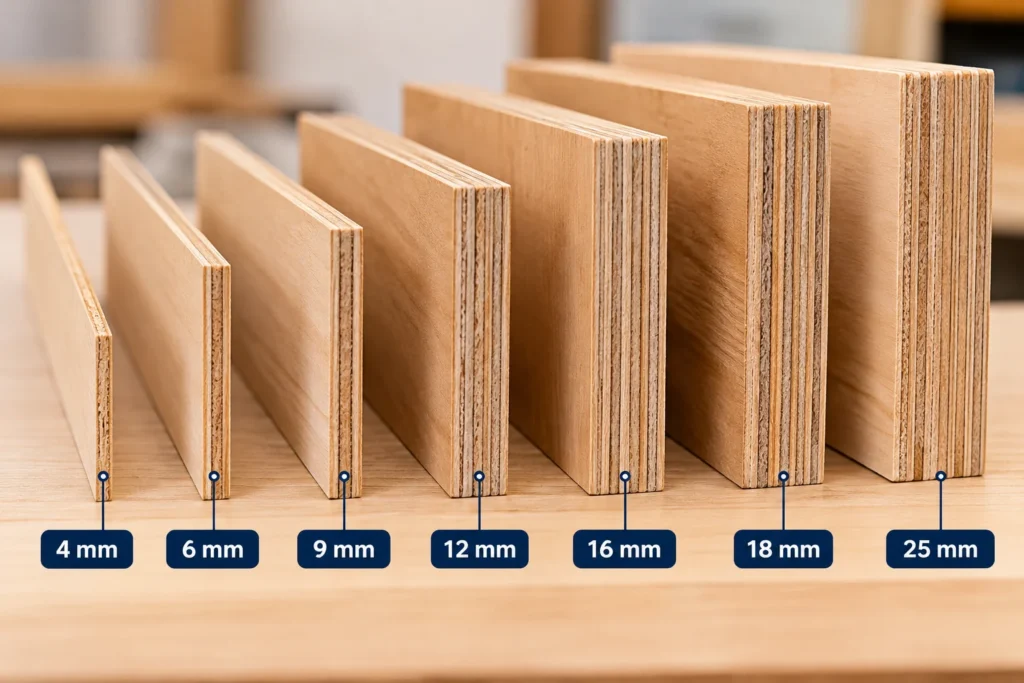
Plywood thickness affects the strength, rigidity, weight, screw-holding performance, and cost of a furniture component.
Choosing a thinner panel to save money may lead to bending or reduced stability if the design requires a thicker panel. On the other hand, unnecessarily thick plywood can increase costs and weight.
Common nominal plywood thicknesses available in India include:
| Thickness | Typical applications |
|---|---|
| 4 mm | Back panels and certain light-duty applications |
| 6 mm | Light-duty panels and selected cabinet backs |
| 9 mm | Some cabinet components and light-duty furniture |
| 12 mm | Selected furniture panels, partitions, and cabinet components |
| 16 mm | Wardrobes, furniture carcasses, and shelving, depending on design |
| 18 mm | Commonly used for kitchen cabinets, wardrobes, beds, and furniture structures |
| 25 mm | Heavy-duty furniture and specialised applications |
These are general examples, not universal specifications. The correct thickness depends on the unsupported span, expected load, support arrangement, fastening method, and furniture design.
Buying tip: Confirm the required thickness with your carpenter or furniture designer before ordering. Also verify the actual thickness tolerance specified for the product.
Not Checking the Core Quality
The core is an important part of plywood construction. Poor core quality may cause uneven surfaces, weak edges, gaps, and reduced screw-holding performance.
Before buying plywood, inspect the exposed edges and look for:
- Large gaps between veneer layers.
- Visible voids or poorly filled cavities.
- Overlapping or uneven core veneers.
- Loose layers or signs of delamination.
- Uneven panel thickness or poorly finished edges.
A smooth face veneer does not automatically mean the internal construction is good.
However, visual inspection alone cannot establish the full internal quality of a panel. For important applications, ask for relevant quality documentation and manufacturer specifications.
Assuming All Plywood Is Waterproof
A frequent misunderstanding is that BWR or BWP plywood can withstand unlimited water exposure.
In reality, water resistance depends on the product construction, adhesive system, manufacturing quality, exposure duration, and installation details. Prolonged wetting, standing water, damaged edges, and poor sealing can still cause problems.
For furniture in kitchens or damp areas:
- Seal exposed edges properly.
- Protect cut-outs around sinks and plumbing.
- Repair damaged laminate and surface finishes.
- Avoid leaving water trapped against the panel.
- Follow the manufacturer’s installation and maintenance guidance.
Buying tip: Choose a suitable plywood grade, but do not depend on the grade alone to protect furniture from leaks or standing water.
Ignoring BIS Standards and Certification
In India, plywood products may be covered by applicable Bureau of Indian Standards (BIS) specifications, depending on the product category and regulatory requirements.
Buyers should check the product label, applicable Indian Standard, manufacturer details, and certification information where required.
Commonly referenced plywood standards include:
- IS 303: General-purpose plywood.
- IS 710: Marine plywood.
The applicable standard and current regulatory requirements should be verified for the specific product. Do not assume that every plywood product marketed as waterproof, marine, or premium automatically meets a particular standard.
Check the authenticity of the certification details rather than relying only on a printed logo or verbal assurance.
Not Checking for Delamination and Bonding Defects
Delamination occurs when plywood layers separate because the bond between them has failed.
Potential contributing factors include inadequate bonding, unsuitable adhesive selection, poor manufacturing control, or severe moisture exposure.
Before purchasing, inspect the panel for:
- Layers separating at the edges.
- Blisters or bubbles on the surface.
- Cracks or visible bond failures.
- Loose veneers and damaged corners.
- Unusual surface irregularities.
A normal shop-floor visual inspection cannot prove that a plywood panel will pass a bonding-strength or water-resistance test. For technical or large-volume purchases, request relevant test reports or product compliance documentation.
Forgetting to Check the Actual Sheet Size
Plywood is commonly sold in standard sheet sizes, including 8 ft × 4 ft, but other dimensions may also be available.
Before purchasing, confirm the actual length, width, thickness, and number of sheets supplied. This is particularly important when calculating material requirements for modular kitchens, wardrobes, and large furniture projects.
For a standard 8 ft × 4 ft sheet:
- Length: 8 feet.
- Width: 4 feet.
- Nominal area: 32 square feet.
However, sheet area alone does not determine how much plywood a project requires. Cutting layouts, grain direction, panel dimensions, and wastage also affect consumption.
Buying tip: Prepare a cutting list before ordering to reduce unnecessary purchases and material wastage.
Choosing the Wrong Plywood for the Application
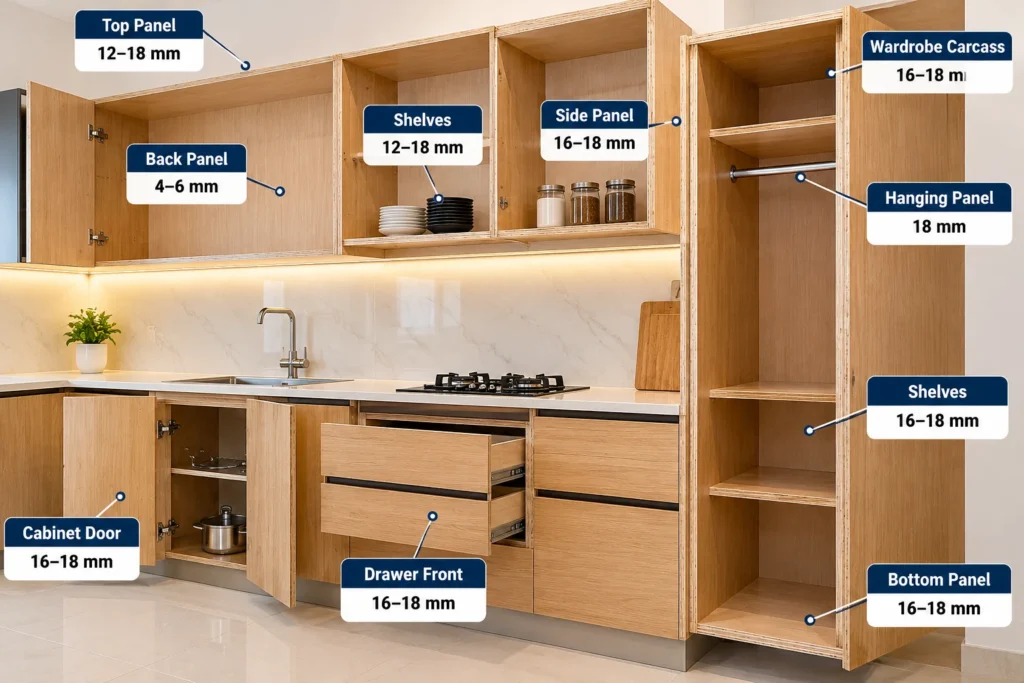
Different furniture applications have different requirements. A plywood product suitable for a bedroom wardrobe may not be the best choice for a kitchen cabinet or a heavily loaded shelf.
| Application | What to consider |
|---|---|
| Bedroom wardrobe | Interior grade suitability, flatness, screw holding, and thickness |
| Modular kitchen | Moisture exposure, bonding performance, edge sealing, and load |
| Bed frame | Structural strength, support design, and fastening |
| Bookshelf | Shelf span, expected weight, stiffness, and thickness |
| Bathroom-adjacent cabinet | Moisture exposure, edge protection, and suitable grade |
| Office furniture | Durability, load, surface finish, and usage frequency |
The correct selection depends on the complete furniture design, not just the name of the application.
Ignoring the Difference Between Plywood, MDF, and Particle Board
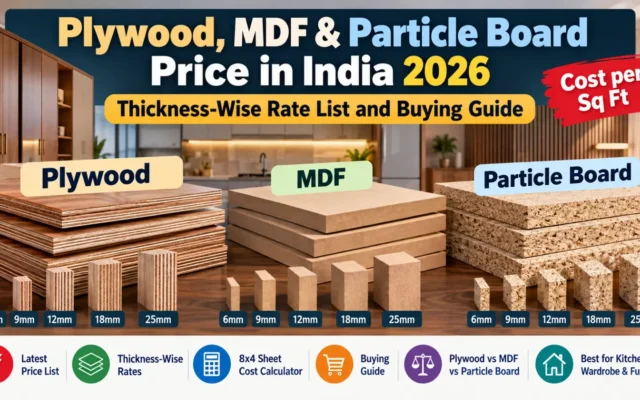
Plywood, medium-density fibreboard (MDF), and particle board are different engineered wood products. They should not be treated as interchangeable in every application.
Plywood
Made by bonding layers of veneer, generally with adjacent veneer grain directions arranged crosswise. It is widely used for furniture, cabinets, partitions, and structural or semi-structural applications according to the grade.
MDF
Made from wood fibres bonded into a panel. It provides a relatively smooth, uniform surface and is commonly used for painted furniture, decorative panels, and routed designs.
Particle Board
Made from wood particles bonded with adhesive. It is widely used in cost-conscious furniture and modular furniture systems, subject to the appropriate grade and design requirements.
Buying tip: Compare the total project cost, intended use, moisture conditions, hardware requirements, finish, and expected service life before choosing between plywood, MDF, and particle board.
Not Comparing Price Per Square Foot Correctly
Comparing plywood prices without checking the product specification can be misleading.
A quotation for 18 mm BWP plywood should not be directly compared with a quotation for 18 mm MR plywood without considering the grade, brand, certification, sheet dimensions, and other relevant features.
To calculate the nominal price per square foot:
Price per sq ft = Price per sheet ÷ Sheet area in sq ft
For example, if an 8 ft × 4 ft plywood sheet costs ₹2,400:
Price per sq ft = ₹2,400 ÷ 32 = ₹75 per sq ft.
This is only an illustrative calculation, not a current market quotation. Actual prices vary by brand, grade, thickness, region, taxes, and dealer.
Ask whether the quoted price includes GST, transportation, cutting, and other applicable charges.
Buying from an Unverified Dealer
Even when you know which plywood grade you need, buying from an unreliable seller can create problems involving product authenticity, damaged stock, incorrect specifications, or unclear warranty coverage.
Before placing an order:
- Check the dealer’s reputation and invoice details.
- Verify the brand and product label.
- Confirm the grade and thickness in writing.
- Ask for applicable warranty terms.
- Inspect sheets for transport damage.
- Retain the invoice for future reference.
For bulk purchases, confirm the product specifications and acceptance criteria before the material is delivered.
Ignoring Storage and Handling Conditions
Plywood quality can deteriorate if sheets are stored incorrectly after purchase.
Poor storage may lead to bending, moisture absorption, surface damage, or difficulties during installation.
For better storage:
- Keep sheets on a flat, level support.
- Store them in a dry, covered area.
- Protect them from rain and direct water contact.
- Avoid uneven stacking and unsupported overhangs.
- Handle sheets carefully to prevent edge damage.
Correct storage is particularly important when plywood will not be installed immediately.
Failing to Plan for Laminate, Veneer, and Edge Finishing
The final furniture performance depends on more than the plywood substrate. Surface finishes, adhesive compatibility, edge banding, and installation quality also matter.
Before purchasing, decide whether the furniture will use decorative laminate, natural veneer, paint, or another finish.
Check that the selected substrate is suitable for the intended finishing process. Ensure exposed edges, cut-outs, and joints receive appropriate protection, especially in moisture-prone areas.
A suitable plywood grade combined with poor installation can still lead to premature furniture damage.
Not Calculating the Total Project Cost
Another mistake is calculating the furniture budget using plywood prices alone.
The final cost may also include:
- Decorative laminates or veneers.
- Adhesives and edge banding.
- Screws, hinges, channels, and handles.
- Labour and fabrication.
- Cutting wastage.
- Transportation and installation.
- Surface finishing and maintenance.
A more expensive plywood product may or may not reduce long-term costs. The decision should be based on the actual performance requirements, purchase price, expected service life, and installation conditions.

Join the discussion