 प्लाईवुड ज्ञान · तकनीक · विशेषज्ञता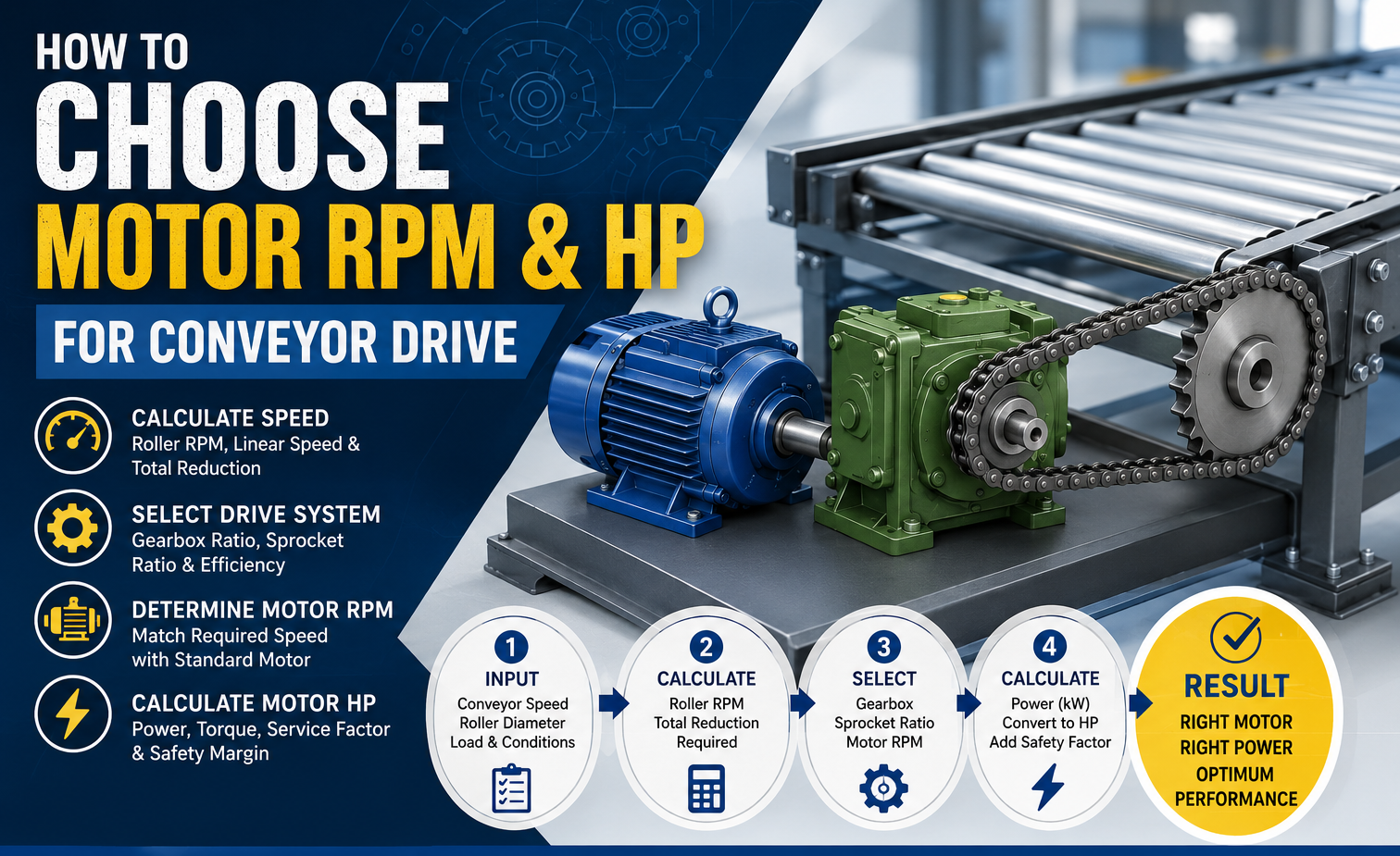
How to Decide Motor RPM and HP for Conveyor Drive System | Complete Calculation Guide
Selecting the correct motor RPM and horsepower (HP) is one of the most important steps in conveyor design. A wrong motor selection can cause low production speed, high power consumption, overheating, vibration, belt slipping, and frequent gearbox failure. In industries such as plywood, laminate, packaging, material handling, and woodworking, proper conveyor speed and power calculation directly affect production efficiency and machine life.
In this article, we will explain step-by-step how to decide conveyor motor RPM, gearbox ratio, sprocket ratio, and motor HP with simple formulas and practical industrial examples.
Why Motor RPM and HP Selection Is Important
Correct motor and gearbox selection provides:
- Stable conveyor speed
- Smooth material movement
- Better energy efficiency
- Long gearbox life
- Reduced maintenance cost
- Better production output
- Lower machine vibration
- Improved safety and reliability
If the motor RPM or HP is selected incorrectly, the conveyor may stop under load, overheat, or run at the wrong speed.
Basic Components of Conveyor Drive System
A standard conveyor drive system generally includes:
- Electric Motor
- Gearbox
- Chain & Sprocket Drive
- Conveyor Roller
- Bearing & Shaft Assembly
The motor produces high RPM, while the gearbox reduces speed and increases torque. The sprocket and chain arrangement finally transfer motion to the conveyor roller.
Step 1: Decide Required Conveyor Speed
The first step is deciding the required conveyor linear speed.
Conveyor speed depends on:
- Production requirement
- Board feeding rate
- Machine synchronization
- Material handling capacity
- Process timing
Conveyor speed is usually measured in:
- Meter per minute (m/min)
Example:
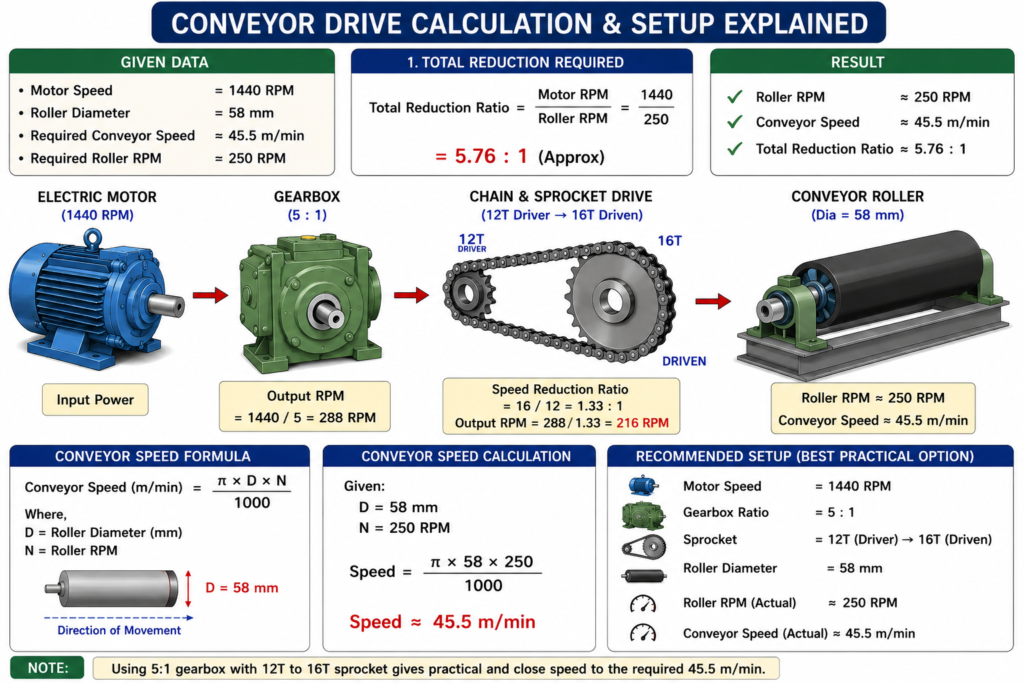
Required conveyor speed = 45.5 m/min
Step 2: Calculate Required Roller RPM
Once conveyor speed is known, calculate conveyor roller RPM.
Formula
Roller RPM (N) = (1000 × Conveyor Speed) / (π × Roller Diameter)
Where:
- N = Roller RPM
- Conveyor Speed = m/min
- Roller Diameter = mm
Practical Example
Given:
- Roller Diameter = 58 mm
- Conveyor Speed = 45.5 m/min
Calculation:
N = (1000 × 45.5) / (3.14 × 58)
N ≈ 250 RPM
Therefore:
Required Roller RPM ≈ 250 RPM
Step 3: Select Motor RPM
Most industrial induction motors are available in standard RPM ranges:
| Motor Type | Approx RPM |
|---|---|
| 2 Pole Motor | 2880 RPM |
| 4 Pole Motor | 1440 RPM |
| 6 Pole Motor | 960 RPM |
| 8 Pole Motor | 720 RPM |
In conveyor systems, the most commonly used motor is:
1440 RPM (4 Pole Motor)
Why?
- Easily available
- Energy efficient
- Compact size
- Suitable for gearbox applications
- Better torque characteristics
- Economical maintenance
Step 4: Calculate Total Reduction Ratio
After selecting motor RPM, calculate total speed reduction.
Formula
Total Reduction Ratio = Motor RPM / Required Roller RPM
Example
Motor RPM = 1440
Required Roller RPM = 250
Total Ratio = 1440 / 250
Total Ratio ≈ 5.76 : 1
This means the complete drive system must reduce motor speed by approximately 5.76 times.
Step 5: Select Gearbox Ratio
Gearboxes are available in standard ratios such as:
- 5 : 1
- 7.5 : 1
- 10 : 1
- 15 : 1
- 20 : 1
- 30 : 1
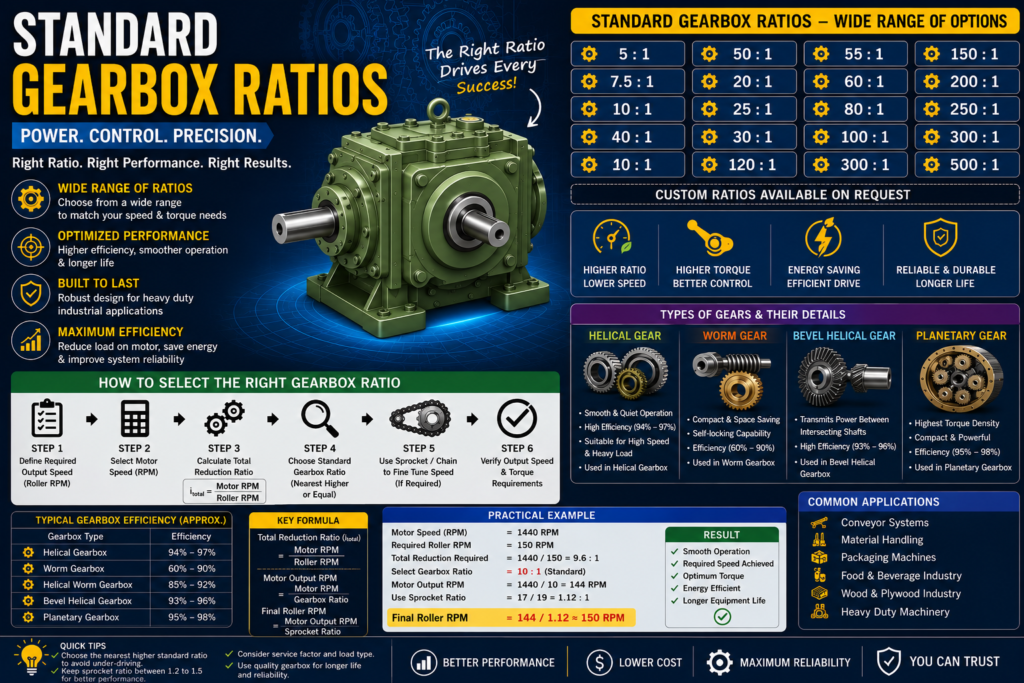
Always select the nearest practical gearbox ratio.
For our example:
Required ratio = 5.76 : 1
Best practical gearbox selection:
5 : 1 Gearbox
Step 6: Calculate Gearbox Output RPM
Formula
Gearbox Output RPM = Motor RPM / Gearbox Ratio
Example:
1440 / 5 = 288 RPM
Therefore:
Gearbox Output RPM ≈ 288 RPM
Step 7: Decide Chain & Sprocket Ratio
Now adjust final speed using chain sprocket arrangement.
Required Roller RPM = 250 RPM
Gearbox Output RPM = 288 RPM
Required sprocket reduction:
288 / 250 = 1.15
A practical sprocket ratio can be:
- 12 Teeth Driver
- 16 Teeth Driven
Ratio:
16 / 12 = 1.33
This provides practical and close speed matching.
Example of Conveyor Speed Calculation
Given:
- Roller Diameter = 88.9 mm
- Roller RPM = 153 RPM
Formula
Conveyor Speed = (π × D × N) / 1000
Where:
- D = Roller Diameter (mm)
- N = Roller RPM
Calculation:
Conveyor Speed = (3.14 × 88.9 × 153) / 1000
Conveyor Speed ≈ 42.7 m/min
How to Calculate Conveyor Motor HP
Selecting proper motor horsepower is equally important.
Motor HP depends on:
- Conveyor load
- Friction
- Material weight
- Conveyor length
- Roller resistance
- Inclination angle
- Starting load
- Operating efficiency
Basic Power Formula
Power at roller:
P = (F × V) / (60000 × Efficiency)
Where:
- P = Power in kW
- F = Pull force in Newton
- V = Conveyor speed in m/min
- Efficiency = Mechanical efficiency
Example Motor HP Calculation
Assume:
- Pull force = 1200 N
- Conveyor speed = 45.5 m/min
- Mechanical efficiency = 0.80
Calculation:
P = (1200 × 45.5) / (60000 × 0.80)
P ≈ 1.14 kW
Now include gearbox and transmission losses.
Final motor power:
≈ 1.5 kW
Convert kW to HP:
1 kW = 1.341 HP
1.5 × 1.341 ≈ 2 HP
For safe operation, always select next higher standard motor.
Recommended Motor:
3 HP Motor
Factors Affecting Conveyor Motor Selection
1. Conveyor Length
Long conveyors require more power.
2. Material Load
Heavy load requires higher torque.
3. Inclination Angle
Inclined conveyors need extra HP.
4. Starting Torque
Loaded starting conditions require high starting torque.
5. Duty Cycle
Continuous operation requires better thermal capacity.
6. Safety Factor
Always keep 10%–25% safety margin.
Common Industrial Conveyor Motor Selection
| Conveyor Type | Typical Motor |
| Light Duty Conveyor | 0.5 – 1 HP |
| Plywood Transfer Conveyor | 2 – 5 HP |
| Heavy Material Conveyor | 5 – 15 HP |
| Hydraulic Feed Conveyor | 10 HP+ |
Recommended Practical Setup
For medium plywood conveyor applications:
- Motor = 1440 RPM
- Gearbox = 5:1 to 7.5:1
- Sprocket Ratio = 1.2 to 1.5
- Roller Diameter = 58–90 mm
- Conveyor Speed = 30–45 m/min
- Motor Power = 2–5 HP
This setup gives:
- Stable operation
- Low vibration
- Better efficiency
- Easy maintenance
- Long gearbox life
Important Tips for Conveyor Design
- Always use standard motor RPM.
- Use proper gearbox lubrication.
- Keep chain alignment correct.
- Avoid excessive sprocket ratio.
- Check bearing load capacity.
- Use VFD if variable speed is required.
- Keep proper service factor for future load increase.
Also Read : How do you calculate wooden Log volume?

Join the discussion