 प्लाईवुड ज्ञान · तकनीक · विशेषज्ञता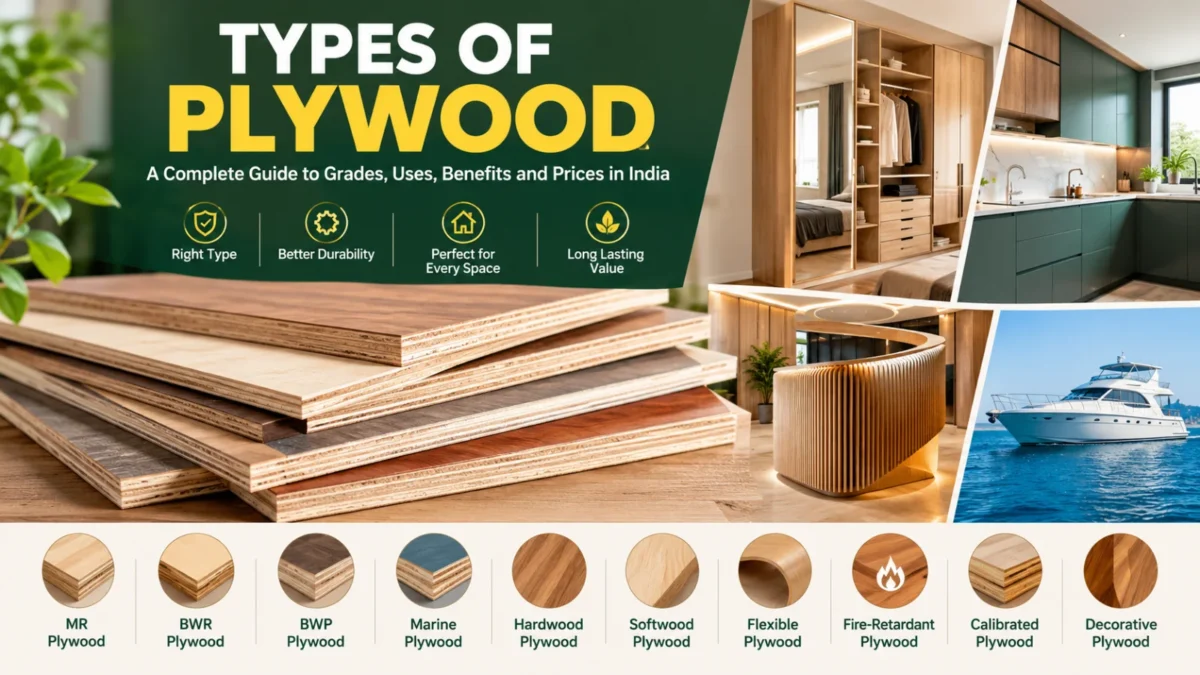
Introduction
Plywood is one of the most widely used engineered wood products in the construction, furniture and interior design industries. From wardrobes and kitchen cabinets to doors, wall panels and commercial interiors, plywood offers a practical combination of strength, versatility and dimensional stability.
However, not all plywood is the same. Different types of plywood are manufactured for different applications, moisture conditions, structural requirements and decorative purposes. Choosing the wrong type can lead to swelling, delamination, premature damage and unnecessary repair costs.
Understanding the different types of plywood helps homeowners, architects, interior designers, contractors and furniture manufacturers make informed purchasing decisions.
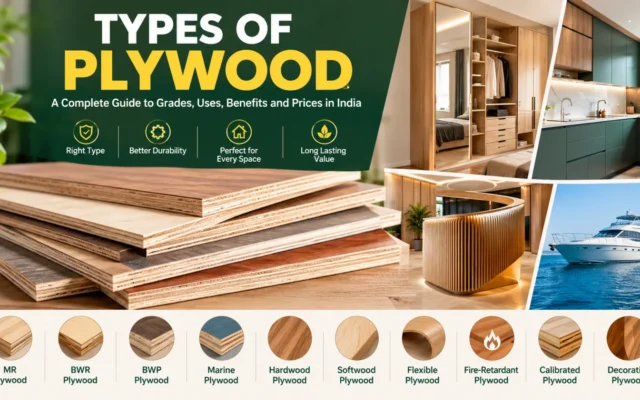
In this comprehensive guide, we will explore the major types of plywood available in India, their features, grades, applications and the important factors to consider before buying plywood.
What Is Plywood?
Plywood is an engineered wood panel made by bonding thin layers of wood veneer together with adhesive. These layers, commonly known as plies, are generally arranged with the grain direction of adjacent veneers at right angles to one another.
This cross-laminated construction helps improve dimensional stability, reduce the effects of wood movement and provide strength in multiple directions.
Depending on the intended application, plywood can be manufactured using different wood species, adhesives, veneer arrangements and surface finishes.
Plywood is commonly used for:
- Residential and commercial furniture
- Kitchen cabinets and wardrobes
- Doors and partitions
- Wall panelling and interior decoration
- Construction and concrete formwork
- Packaging and industrial applications
- Specialised curved and fire-retardant applications
The right plywood selection depends on the environment, expected load, exposure to moisture, surface requirements and applicable quality standards.
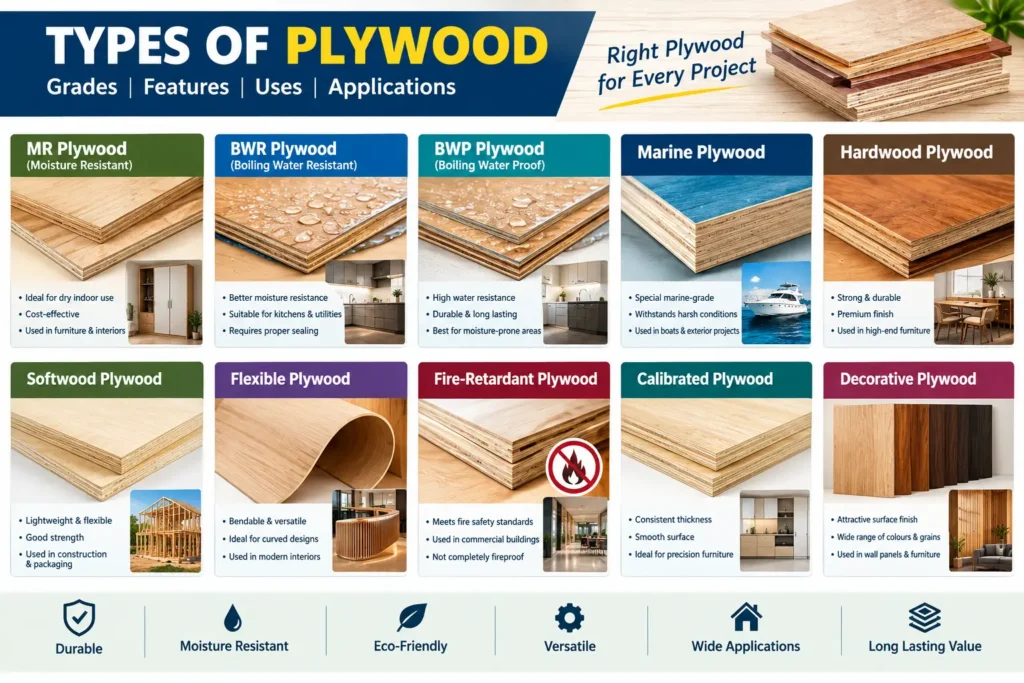
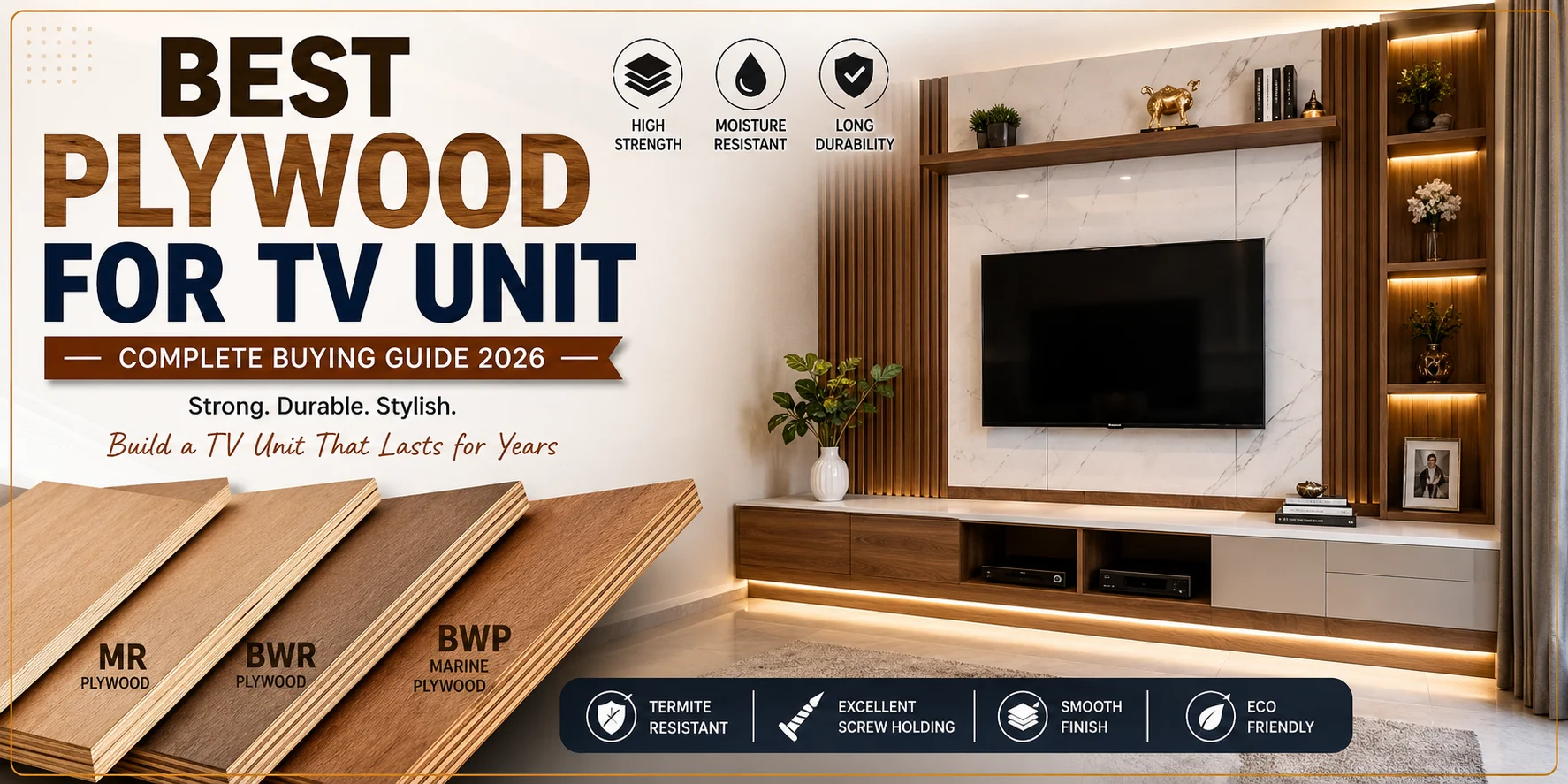
1. MR Grade Plywood (Moisture Resistant Plywood)
MR plywood, commonly called moisture-resistant plywood, is widely used for interior furniture and applications where the panel is not expected to experience prolonged wet conditions.
It is often referred to as commercial plywood in the Indian market, although product quality and specifications can vary between manufacturers.
Key Features of MR Plywood
- Suitable for general interior applications.
- Offers good performance under normal indoor conditions.
- Available in different thicknesses and surface finishes.
- Commonly used for furniture and decorative interior work.
- Generally more economical than specialised exterior-grade plywood.
Common Applications
MR plywood is suitable for:
- Bedroom wardrobes
- Study tables and office furniture
- Bookshelves and storage cabinets
- TV units and display shelves
- Interior partitions in dry areas
Important: MR plywood is not waterproof. It should not be selected for areas exposed to repeated wetting, standing water or prolonged high humidity without appropriate protection and product-specific suitability.
2. BWR Grade Plywood (Boiling Water Resistant Plywood)
BWR plywood is designed to provide improved resistance to moisture compared with ordinary interior-grade plywood. It is commonly considered for furniture and interior applications where occasional moisture exposure may occur.
Its actual performance depends on the adhesive system, veneer quality, manufacturing process and compliance with the relevant product specification.
Key Features of BWR Plywood
- Better moisture resistance than typical MR-grade plywood.
- Suitable for selected applications in moisture-prone interiors.
- Commonly used for kitchen and utility furniture.
- Available in a variety of thicknesses and decorative finishes.
- Requires appropriate sealing and installation for long-term performance.
Common Applications
BWR plywood is frequently considered for:
- Kitchen cabinets
- Bathroom storage furniture in suitably protected locations
- Utility cabinets
- Furniture near sinks, subject to proper waterproofing
- Interior applications with occasional moisture exposure
Is BWR plywood waterproof?
BWR plywood is moisture-resistant, but it should not automatically be treated as fully waterproof or suitable for permanent immersion. The manufacturer’s technical specifications should be checked before using it in demanding environments.
3. BWP Grade Plywood (Boiling Water Proof Plywood)
BWP plywood is designed for applications requiring a higher level of water resistance. In India, the term is frequently associated with premium waterproof plywood, but buyers should verify the declared grade, applicable standard and product certification rather than relying on the label alone.
Key Features of BWP Plywood
- Designed for demanding moisture-exposure conditions within its specified use.
- Commonly used for selected kitchen and utility applications.
- Available in different thicknesses and finishes.
- Suitable for projects where durability and moisture resistance are important.
- Requires correct edge sealing, installation and maintenance.
Common Applications
- Kitchen cabinets and furniture
- Utility areas
- Selected moisture-prone interior installations
- Furniture requiring enhanced moisture resistance
- Applications specified by the manufacturer for the intended exposure
BWP plywood is often marketed as waterproof plywood. However, water resistance does not mean that every panel can withstand continuous immersion, untreated edges or unlimited exposure to water.
4. Marine Plywood
Marine plywood is a specialised plywood product manufactured for demanding applications where moisture resistance and bonding performance are important.
In India, marine plywood is commonly associated with IS 710-compliant products. Buyers should verify the applicable standard, certification and product documentation before purchase.
Key Features of Marine Plywood
- Manufactured to meet specific marine-plywood requirements.
- Designed for demanding moisture-related applications.
- Suitable for selected marine and exterior applications when correctly specified.
- Available in different thicknesses.
- Requires suitable protective coatings, edge sealing and installation where exposure conditions demand them.
Common Applications
- Boat and marine interiors
- Selected exterior applications
- Furniture in demanding moisture-prone environments
- Specialised construction and industrial projects
- Applications specified for marine-grade panels
Marine Plywood vs BWP Plywood
Marine plywood and BWP plywood are not automatically interchangeable. They may serve overlapping applications, but the relevant standards, construction requirements and intended uses can differ.
For marine or particularly demanding projects, choose a product specifically documented for the application rather than relying solely on a general waterproof claim.
5. Hardwood Plywood
Hardwood plywood is manufactured using hardwood species in its veneer construction. The specific wood species, core composition and adhesive system vary by product.
It is valued for applications where strength, surface quality, durability or a particular finish is required.
Key Features
- Available in different wood species and constructions.
- Can provide good strength and dimensional stability.
- Suitable for furniture and interior joinery.
- Can support decorative laminates, veneers and other surface finishes.
- Performance varies according to the species and manufacturing quality.
Common Applications
- Premium furniture
- Cabinets and wardrobes
- Office interiors
- Decorative wall panels
- Doors and joinery
Hardwood plywood is not automatically waterproof or superior for every application. The grade, construction and adhesive system must match the intended use.
6. Softwood Plywood
Softwood plywood is manufactured using veneers from softwood species. Depending on its construction and grade, it may be used for construction, packaging, furniture components and general-purpose panels.
Key Features
- Available in different structural and non-structural grades.
- Can be suitable for construction and industrial applications.
- Offers flexibility in panel selection depending on the required strength and thickness.
- May be specified for structural uses where appropriate certification is available.
Common Applications
- Construction panels
- Packaging and crates
- Subflooring and sheathing where specified
- General-purpose panel applications
- Selected furniture components
For load-bearing or structural applications, always verify the relevant structural rating and technical documentation.
7. Flexible Plywood
Flexible plywood, also called bendable plywood, is specially manufactured to bend into curves more easily than conventional rigid plywood.
It is particularly useful for creative interior designs and furniture requiring rounded forms.
Key Features
- Designed to accommodate curved shapes.
- Useful for decorative and customised furniture.
- Available in different thicknesses and bending orientations.
- Can be finished with veneer, laminate or other compatible materials.
- Requires appropriate support and finishing techniques.
Common Applications
- Curved furniture
- Rounded reception desks
- Decorative columns
- Curved wall panels
- Contemporary interior designs
- Specialised furniture and display units
Flexible plywood is generally selected for shape and design requirements rather than as a direct substitute for structural plywood.
8. Fire-Retardant Plywood
Fire-retardant plywood is specially treated or manufactured to improve fire-performance characteristics according to a specified test or classification.
It may be required in selected commercial, institutional and public-building applications.
Key Features
- Designed to meet specified fire-performance requirements.
- Available in products with different fire classifications.
- Must be supported by relevant test reports or certification.
- May require compatible finishing systems and installation methods.
Common Applications
- Commercial interiors
- Office fit-outs
- Hotels and hospitality projects
- Institutional interiors
- Projects where fire-performance specifications apply
Important: Fire-retardant plywood is not fireproof. Before purchase, verify the applicable fire-test classification and confirm that the product meets the project’s local building-code requirements.
9. Calibrated Plywood
Calibrated plywood is manufactured or sanded to achieve a more consistent thickness and surface uniformity. It is useful in furniture production where accurate dimensions and a smooth base are important.
Key Features
- More consistent panel thickness.
- Suitable for precision-oriented furniture manufacturing.
- Can provide a better base for laminates and decorative finishes.
- Helps improve alignment during fabrication.
- Available in different grades and constructions.
Common Applications
- Modular furniture
- Kitchen cabinets
- Wardrobes
- CNC-cut furniture components
- Laminate-finished panels
Calibration refers primarily to thickness accuracy. It does not, by itself, indicate that the plywood is waterproof, structurally rated or suitable for outdoor exposure.
10. Decorative Plywood
Decorative plywood is designed for applications where the visible surface is an important part of the finished design. It may feature natural wood veneer or other decorative surface treatments.
Key Features
- Available in different colours, grains and textures.
- Offers an attractive finished appearance.
- Can reduce the need for additional decorative surface treatments in some applications.
- Suitable for customised interior designs.
- Requires appropriate care and protection according to the surface finish.
Common Applications
- Decorative wall panelling
- Premium furniture
- Cabinet fronts
- Reception counters
- Office and hospitality interiors
- Feature walls and display units
Decorative plywood is selected primarily for its appearance. Its moisture resistance and structural suitability depend on the underlying panel and product specifications.
Quick Comparison of Different Types of Plywood
The following table provides a general guide to the common plywood categories available in India.
| Type of Plywood | Main Characteristic | Common Applications |
|---|---|---|
| MR Plywood | General interior moisture resistance | Wardrobes, tables, shelves |
| BWR Plywood | Enhanced moisture resistance | Selected kitchen and utility furniture |
| BWP Plywood | Higher water-resistance performance | Specified demanding interior applications |
| Marine Plywood | Specialised marine-grade requirements | Marine applications and specified projects |
| Hardwood Plywood | Hardwood veneer construction | Furniture and joinery |
| Softwood Plywood | Softwood veneer construction | Construction and packaging |
| Flexible Plywood | Designed for bending | Curved furniture and panels |
| Fire-Retardant Plywood | Specified fire-performance properties | Commercial and institutional interiors |
| Calibrated Plywood | Consistent panel thickness | Modular furniture and precision fabrication |
| Decorative Plywood | Appearance-focused surface | Wall panels and premium interiors |
Note: These categories overlap. For example, a plywood panel can be hardwood, calibrated and moisture-resistant at the same time. The table describes broad product categories, not mutually exclusive grades.
Which Plywood Is Best for Different Applications?
Choosing the best plywood starts with understanding where and how it will be used.
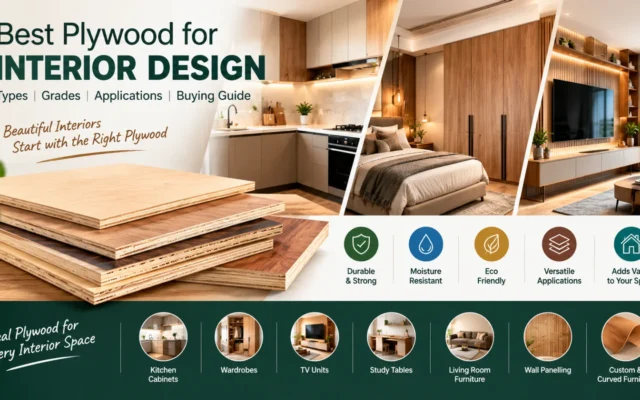
Best Plywood for Wardrobes
MR plywood is a common choice for wardrobes in dry indoor environments. Calibrated plywood can be useful when accurate dimensions and consistent surfaces are required for modular furniture.
Best Plywood for Kitchen Cabinets
BWR or BWP plywood may be appropriate depending on the moisture exposure and product specification. Areas around sinks and plumbing require special attention to edge sealing, joints and leak prevention.
Best Plywood for Bathroom Furniture
Choose a product specifically suitable for the expected moisture conditions. Even moisture-resistant plywood can be damaged by persistent leaks, standing water or unsealed edges.
Best Plywood for Premium Furniture
Hardwood plywood, calibrated plywood or decorative plywood may be suitable depending on the desired finish, dimensional accuracy and construction requirements.
Best Plywood for Curved Furniture
Flexible plywood is specifically designed for curved shapes and rounded designs.
Best Plywood for Marine Applications
Select marine plywood that meets the relevant specification, such as applicable IS 710 requirements in India, and confirm that it is suitable for the actual exposure conditions.
Best Plywood for Commercial Interiors
Depending on the project, calibrated, decorative or certified fire-retardant plywood may be appropriate. Check the project’s technical and regulatory requirements before selecting a product.
How to Choose the Right Plywood: 7 Important Factors
Before buying plywood, consider the following points.
1. Application: Determine whether the plywood will be used for furniture, cabinets, decorative panels, construction or marine applications.
2. Moisture exposure: Assess whether the panel will remain dry, experience occasional moisture or face demanding water-exposure conditions.
3. Thickness: Select the thickness according to the design, dimensions, support spacing, hardware and expected load. Do not assume that thickness alone determines strength.
4. Quality and construction: Examine the panel for visible defects, uneven thickness, damaged edges and signs of poor bonding. Ask about veneer construction and quality-control procedures.
5. Applicable standards: Verify the relevant Indian Standard, certification and product documentation where applicable. For example, IS 303 and IS 710 are associated with different plywood product requirements.
6. Surface finish: Consider whether the panel will receive laminate, veneer, paint or another finish.
7. Manufacturer warranty and documentation: Review the warranty conditions, declared grade, intended use and maintenance recommendations before purchasing.
A reliable plywood selection balances performance, application suitability and overall project cost rather than focusing only on the lowest price.
Common Plywood Buying Mistakes to Avoid
Avoid these common mistakes when purchasing plywood:
- Buying MR plywood for an application that requires greater moisture resistance.
- Assuming that all BWR, BWP and marine plywood products are identical.
- Selecting plywood based only on thickness or price.
- Ignoring edge sealing and proper installation.
- Using decorative plywood without checking its underlying grade.
- Treating fire-retardant plywood as completely fireproof.
- Failing to verify product certifications and technical specifications.
- Ignoring the manufacturer’s instructions for storage, handling and finishing.
Correct selection and installation can help improve the service life of plywood products and reduce avoidable maintenance costs.
Conclusion
Understanding the different types of plywood is essential for choosing the right material for furniture, construction and interior design projects. MR plywood is commonly used for dry indoor applications, BWR and BWP plywood offer different levels of moisture resistance, and marine plywood is designed for specialised requirements. Hardwood, softwood, flexible, calibrated, decorative and fire-retardant plywood serve additional purposes.
The best plywood is not necessarily the most expensive option. It is the product that matches the intended application, environmental conditions, quality requirements and budget.
Before making a purchase, compare technical specifications, verify applicable standards and follow the manufacturer’s recommendations for installation and maintenance. Making an informed choice can help deliver better performance, durability and value over the long term.
Choose the right plywood for the right application to build furniture and interiors that last.
Join the discussion