
Why Does Plywood Bend? Complete Guide to Prevent Warping
Plywood is one of the strongest and most stable engineered wood products, but many homeowners, carpenters, furniture manufacturers, and contractors still face one frustrating problem—bent or warped plywood.
Whether you’re building a modular kitchen, wardrobe, office furniture, or installing plywood on-site, bending can ruin the appearance, reduce strength, and increase production costs.
The good news? Most plywood bending issues are preventable.
In this guide, you’ll learn why plywood bends, the science behind plywood warping, how to identify the causes, and the best ways to prevent it.
Table of Contents
What is Plywood Bending?
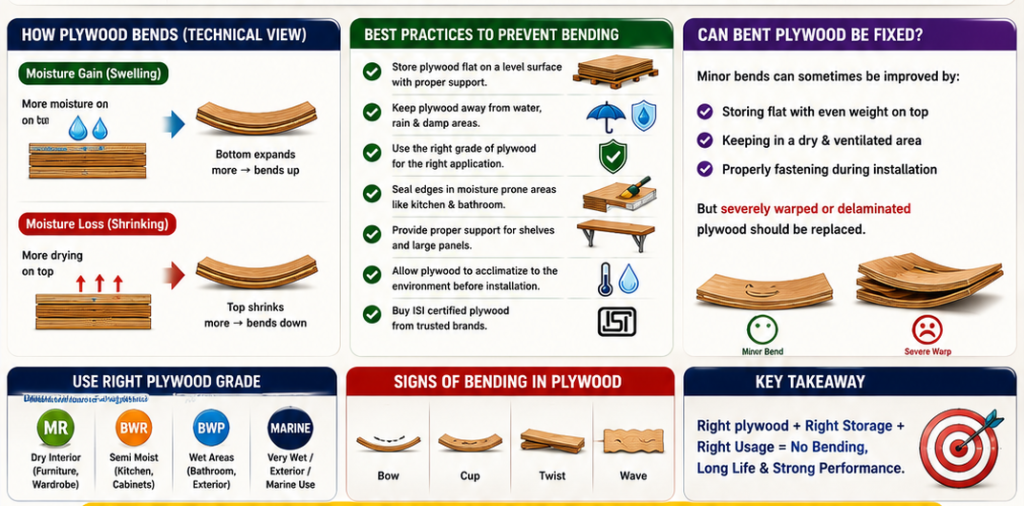
Plywood bending refers to a change in the shape of a plywood sheet caused by uneven internal stresses or environmental conditions.
The plywood may become:
- Bowed
- Curved
- Twisted
- Warped
- Wavy
- Cupped
Even premium plywood can bend if it is stored or used incorrectly.
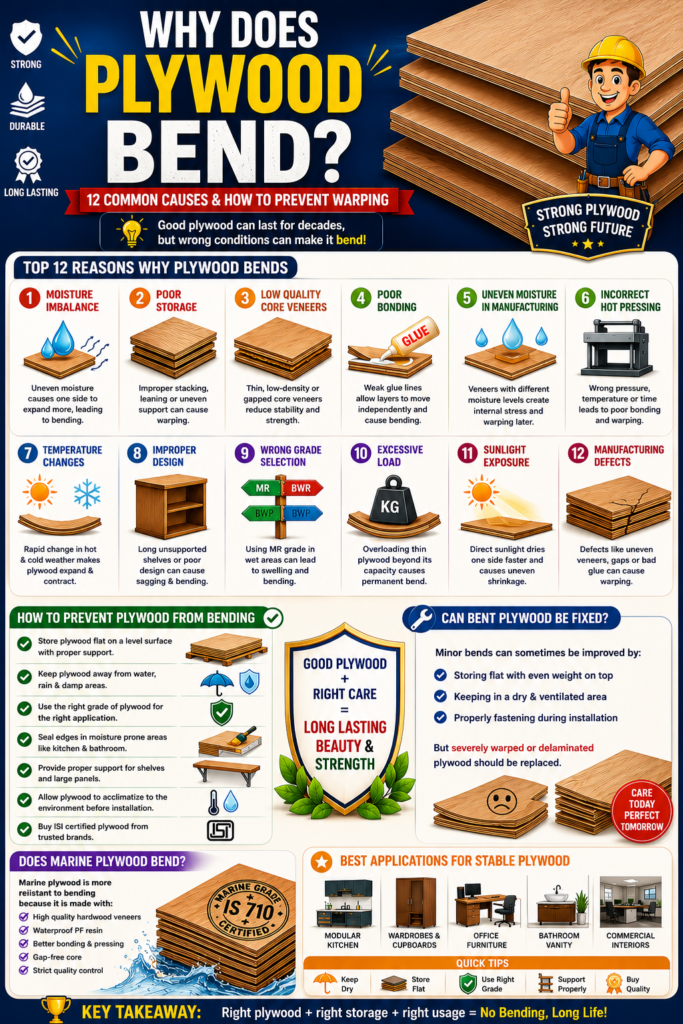
1. Moisture is the Biggest Reason
The most common cause of plywood bending is uneven moisture absorption.
When one side absorbs more moisture than the other, the wood fibers expand unevenly, causing the sheet to curve.
Common situations include:
- Rain exposure
- Water leakage
- High humidity
- Wet construction sites
- Improper storage
Prevention
- Store plywood in a dry location.
- Avoid direct contact with water.
- Seal exposed edges when necessary.
- Use Marine/BWP plywood in wet areas.
2. Poor Storage
Many plywood sheets bend before they are even used.
Common mistakes include:
- Leaning sheets against a wall
- Uneven support
- Keeping heavy material on one edge
- Long-term vertical storage
Correct Storage Method
Always store plywood:
- Flat on a level surface
- With support every 400–600 mm
- Covered from rain and sunlight
- Away from damp floors
3. Low-Quality Core Veneers
The core is the backbone of plywood.
If manufacturers use:
- Thin veneers
- Low-density wood
- Gaps between layers
- Uneven veneer thickness
the plywood becomes unstable and bends easily.
Premium plywood uses high-density hardwood veneers with minimal core gaps.
4. Poor Bonding
Weak glue lines allow veneer layers to move independently.
This results in:
- Delamination
- Bending
- Cracks
- Reduced strength
High-quality plywood uses Phenol Formaldehyde (PF) or Melamine Urea Formaldehyde (MUF) adhesives, depending on the grade.
5. Uneven Moisture Content During Manufacturing
During production, veneers must be dried to the correct moisture level.
If some veneers are wetter than others before pressing, internal stress develops.
Over time, the plywood may warp as moisture equalizes.
6. Incorrect Hot Pressing
The hot press is one of the most critical stages in plywood manufacturing.
If:
- Pressure is uneven
- Temperature is too low
- Pressing time is insufficient
bonding becomes inconsistent, increasing the risk of bending later.
7. Extreme Temperature Changes
Rapid shifts between hot and cold environments can cause plywood to expand and contract.
Examples:
- Outdoor storage
- Direct sunlight
- Factory sheds without ventilation
- Transportation in extreme weather
8. Improper Furniture Design
Sometimes the plywood is not the problem.
Furniture can bend because of:
- Long unsupported shelves
- Thin plywood used for heavy loads
- Missing support members
- Poor frame design
9. Wrong Plywood Grade
Different applications require different plywood grades.
| Area | Recommended Grade |
|---|---|
| Bedroom | MR Grade |
| Wardrobe | MR/BWR |
| Kitchen | BWR |
| Bathroom | Marine/BWP |
| Outdoor | Marine Grade |
Using MR plywood in high-moisture areas often leads to warping.
10. Excessive Load
Plywood is strong, but every thickness has a load limit.
For example:
- A long bookshelf without center support may sag over time.
- Thin shelves carrying heavy books or appliances are more likely to bend.
Choose the correct thickness for the application.
11. Exposure to Sunlight
Direct sunlight can dry one side of the plywood faster than the other, causing uneven shrinkage.
Always store sheets in shaded, ventilated areas.
12. Manufacturing Defects
Occasionally, bending occurs due to factory defects such as:
- Uneven veneer alignment
- Core gaps
- Improper pressing
- Poor-quality glue
- Low-density veneers
Buying from trusted brands reduces this risk.
How to Prevent Plywood from Bending
Follow these best practices:
- Store plywood flat on a level surface.
- Keep it away from rain and standing water.
- Use the correct plywood grade for the environment.
- Seal exposed edges in moisture-prone areas.
- Provide adequate support for shelves and panels.
- Acclimatize plywood to the installation site before use.
- Purchase ISI-certified plywood from reputable manufacturers.
Can Bent Plywood Be Fixed?
Sometimes, yes.
Minor bends may improve by:
- Storing the sheet flat with even weight on top.
- Allowing the plywood to acclimatize in a dry environment.
- Correctly fastening it during installation.
However, severely warped or delaminated plywood should usually be replaced.
Does Marine Plywood Bend?
Marine plywood is more resistant to bending because it is made with:
- High-quality hardwood veneers
- Waterproof PF resin
- Better bonding
- Gap-free core
- Strict quality control
However, even marine plywood can warp if exposed to poor storage conditions or prolonged moisture imbalance.
Frequently Asked Questions
Why does new plywood bend?
New plywood often bends because of improper storage, moisture imbalance, or internal stresses from manufacturing.
Which plywood bends the least?
High-quality IS 710 Marine Plywood or premium BWP plywood generally offers the best dimensional stability.
Can rain damage plywood?
Yes. Repeated exposure to rain can cause swelling, warping, and eventual delamination, especially in non-waterproof grades.
Is thicker plywood less likely to bend?
Generally, yes. Thicker plywood provides greater stiffness and resists bending better than thinner sheets.
Plywood bending is usually caused by a combination of moisture, storage practices, manufacturing quality, and application errors. By selecting certified plywood, storing it correctly, and using the appropriate grade for the job, you can significantly reduce the risk of warping.
For kitchens, bathrooms, and humid environments, investing in high-quality Marine or BWP plywood is often worth the additional cost due to its superior stability and durability.