प्लाईवुड ज्ञान · तकनीक · विशेषज्ञता
Reference tables and notes
What Is IS 19952:2026?
IS 19952:2026 is the Indian Standard titled Flexible Plywood – Specification. It is intended specifically for flexible plywood, which is designed to bend into curved shapes for furniture, decorative panels and architectural applications.
Unlike conventional plywood, which is generally manufactured for flat-panel applications, flexible plywood is designed to accommodate curved surfaces and specialised interior designs.
The standard provides a framework for evaluating flexible plywood quality, including relevant considerations such as glue-bond strength, bending performance, surface quality and formaldehyde emissions.
For manufacturers, the standard is relevant to product development, quality control and the selection of appropriate testing procedures. Buyers and designers can use the applicable specification to understand product suitability for their intended applications.
Key Specifications and Quality Requirements of Flexible Plywood
The following areas are important when evaluating flexible plywood under the applicable Indian Standard.
Product Classification
Flexible plywood products may be classified according to the requirements defined in the applicable specification. Manufacturers should consult the official standard for the exact classifications, terminology and grade designations.
Correct product classification helps manufacturers, distributors and customers identify the intended use of the plywood.
Glue-Bond Strength
Glue-bond strength is an important quality parameter in plywood manufacturing. The adhesive must provide suitable bonding between the veneer layers to maintain panel integrity during handling, fabrication and use.
Poor bonding can contribute to delamination and product failure. Manufacturers should follow the applicable test methods and acceptance criteria specified by BIS.
Moisture Resistance
Moisture resistance is an important consideration when selecting plywood for different environments.
The required level of resistance depends on the intended application and the product classification. Manufacturers and buyers should verify the applicable grade requirements rather than assuming that every flexible plywood product is suitable for wet conditions.
BWR and BWP Grades
BWR and BWP are established terms used in the Indian plywood industry.
- BWR: Boiling Water Resistant.
- BWP: Boiling Water Proof.
The applicable standard determines the requirements associated with each product classification. Buyers should check the product documentation and relevant test requirements before selecting a grade.
Formaldehyde Emissions
Formaldehyde emissions are relevant to indoor air quality and the safe use of wood-based panels.
Manufacturers should verify the emission requirements, test procedures and applicable limits specified in the official standard. Numerical limits should not be assumed without consulting the published document.
Bending Performance
Bending performance is a defining consideration for flexible plywood.
The panel should be suitable for the intended curved application, taking into account its construction, thickness, bending direction, minimum achievable radius and fabrication method.
The actual bending capability varies with product design and manufacturing characteristics. A sample should be tested under the intended working conditions before large-scale use.
Surface Quality
Surface quality influences the appearance and finishing of flexible plywood.
Manufacturers should inspect the product for relevant defects, including surface irregularities, cracks, veneer separation and other defects covered by the applicable specification.
Consistent surface quality is particularly important when the plywood will receive decorative laminates, veneers, paint or other finishing materials.
Applications of Flexible Plywood
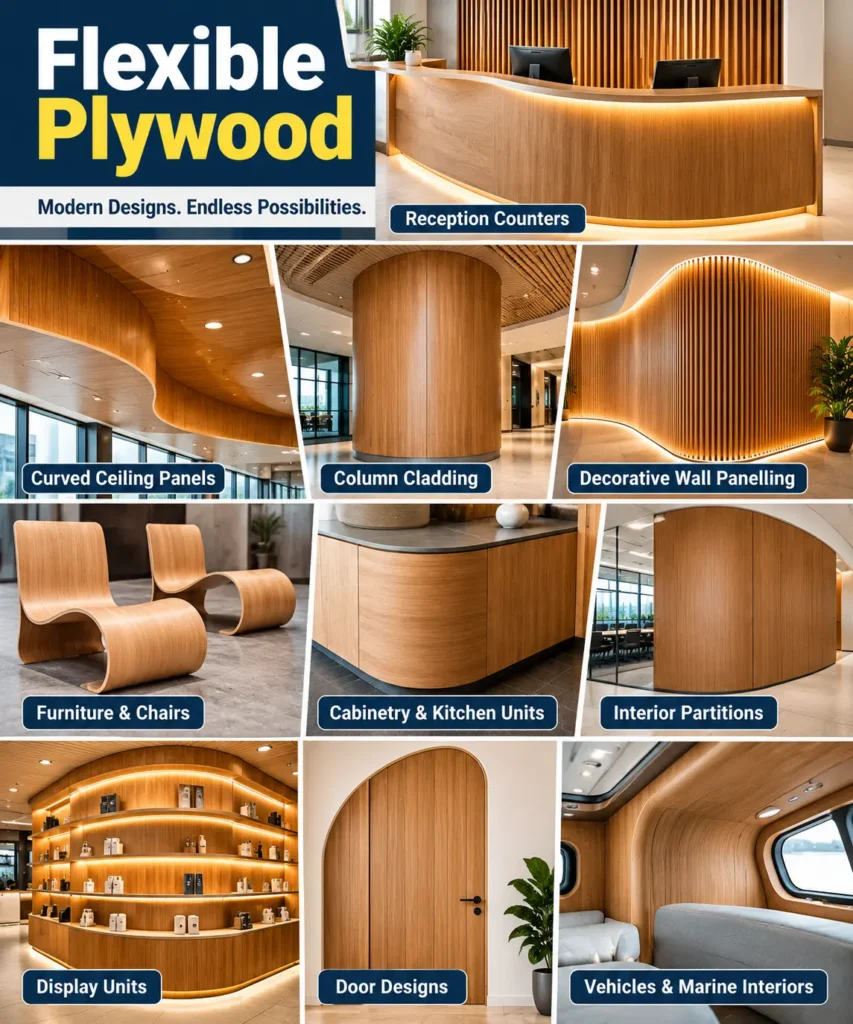
Flexible plywood is used in applications where conventional flat plywood may be difficult to shape into the required design.
Curved Reception Counters
Flexible plywood can be used to create curved reception counters in hotels, offices, hospitals, retail outlets and commercial buildings.
Its ability to accommodate curved surfaces helps designers create customised reception areas with a continuous, smooth appearance.
Curved Ceiling Panels
Flexible plywood can be incorporated into selected curved ceiling designs and decorative ceiling features.
The supporting framework, fixing system, panel thickness and installation method must be suitable for the intended application.
Column Cladding
Flexible plywood can be used to cover selected round or curved columns in commercial and residential interiors.
This application allows designers to create a consistent wood finish around curved structural elements.
Decorative Wall Panelling
Curved wall panelling is a popular feature in contemporary interior design.
Flexible plywood can be used to create wave-shaped panels, rounded wall features and other decorative surfaces, subject to the panel’s bending capability and installation requirements.
Furniture and Chairs
Flexible plywood is useful for selected curved furniture components, including chair shells, decorative furniture fronts and customised seating designs.
The required strength, thickness and construction depend on the furniture design and loading conditions.
Cabinetry and Kitchen Units
Curved cabinet fronts, rounded storage units and customised furniture components can incorporate flexible plywood.
For kitchen applications, the product must be selected according to the expected moisture exposure, finishing system and service conditions.
Interior Partitions
Flexible plywood can be used in selected curved partitions and decorative dividers in offices, hotels, showrooms and residential spaces.
Designers should consider structural support, fixing arrangements, fire-safety requirements and the intended service environment.
Display Units and Retail Fixtures
Retail displays, exhibition stands and product showcases frequently use curved shapes to improve visual presentation.
Flexible plywood can help create rounded display shelves, curved product counters and customised commercial fixtures.
Curved Doors and Decorative Panels
Flexible plywood may be used for selected curved door components and decorative architectural panels.
The suitability of the product depends on the door construction, hardware, thickness, fixing method and expected operating conditions.
Vehicle and Marine Interiors
Flexible plywood may be suitable for certain specialised vehicle or marine interior applications when the product’s construction and performance meet the relevant requirements.
Marine exposure, fire safety, vibration, moisture and other application-specific requirements must be assessed separately. Compliance with a flexible plywood standard alone should not be taken as proof of suitability for every vehicle or marine application.
Why Is IS 19952:2026 Important for Plywood Manufacturers?
A dedicated flexible plywood specification gives the industry a defined reference for assessing the product category and its quality requirements.
Manufacturers should review the following areas when evaluating their production and quality-control systems.
Raw material selection: Veneer quality, thickness consistency and suitability for the intended panel construction.
Adhesive and bonding: Adhesive selection, application consistency, pressing conditions and compliance with the relevant bond-strength requirements.
Bending performance: Verification that the finished panel can achieve the intended curvature without unacceptable cracking or delamination.
Surface inspection: Monitoring veneer defects, surface irregularities and finishing suitability.
Formaldehyde emissions: Checking the applicable emission requirements and testing procedures.
Quality documentation: Maintaining appropriate production records, inspection reports, test results and product identification.
These are practical quality-control considerations. The official standard must be consulted to determine which requirements and tests are mandatory.
Difference Between IS 19952:2026, IS 303 and IS 710
India has separate standards for different plywood product categories. Selecting the correct specification is important because different products have different intended applications and performance requirements.
| Indian Standard | Product category | Main purpose |
|---|---|---|
| IS 19952:2026 | Flexible plywood | Specification for flexible plywood |
| IS 303:2024 | Plywood for general purposes | General-purpose plywood requirements |
| IS 710:2024 | Marine plywood | Marine plywood requirements |
These standards should not be treated as interchangeable.
Flexible plywood is intended for applications involving bending and curved surfaces. General-purpose plywood is used across a range of conventional applications, while marine plywood is covered by a separate specification.
The appropriate standard depends on the product category and intended use. Additional requirements may apply to specialised installations.
Is BIS Certification Mandatory for Flexible Plywood?
The publication of an Indian Standard does not automatically mean that every product covered by it must carry the BIS Standard Mark.
Manufacturers should verify whether an applicable Quality Control Order, government notification or other legal requirement makes certification compulsory for the particular product.
Before claiming that flexible plywood is BIS-certified or that the ISI Mark is mandatory, check the current requirements through the official Bureau of Indian Standards website.
Manufacturers should also confirm the applicable product-certification scheme, testing requirements and any relevant amendments before making compliance claims.
Quality-Control Checklist for Flexible Plywood Manufacturers
The following checklist can help organise internal quality-control reviews. It does not replace the mandatory tests or acceptance criteria in the official standard.
- Verify the product classification and intended application.
- Inspect veneer quality and thickness consistency.
- Monitor adhesive preparation and application.
- Review pressing conditions and production records.
- Evaluate glue-bond strength using the applicable test method.
- Assess bending performance for the intended radius and direction.
- Inspect surface quality and visible defects.
- Verify applicable formaldehyde emission requirements.
- Maintain traceable inspection and testing records.
- Review the current BIS standard and any applicable certification requirements.
Frequently Asked Questions About IS 19952:2026
1. What is IS 19952:2026?
IS 19952:2026 is the Indian Standard titled Flexible Plywood – Specification. It addresses the specification for flexible plywood intended for applications involving curved surfaces.
2. What is flexible plywood used for?
Flexible plywood is used in curved reception counters, wall panelling, selected ceiling designs, column cladding, furniture, cabinetry, display units and other specialised interior applications.
3. What are BWR and BWP plywood grades?
BWR stands for Boiling Water Resistant, while BWP stands for Boiling Water Proof. The precise requirements and classification must be checked against the applicable product standard.
4. Does IS 19952:2026 cover formaldehyde emissions?
Formaldehyde emissions are identified as a relevant requirement in published information concerning the standard. The exact limits and testing procedures should be confirmed from the official specification.
5. Can flexible plywood be used for kitchen furniture?
It can be considered for suitable curved cabinet components, provided the selected product, adhesive system, finish and installation are appropriate for the expected moisture exposure and service conditions.
6. Is flexible plywood the same as marine plywood?
No. Flexible plywood and marine plywood are separate product categories covered by different Indian Standards. Their suitability depends on the intended application and the applicable performance requirements.
7. Does flexible plywood always bend without cracking?
No. Bending capability depends on the panel construction, thickness, veneer orientation, moisture condition, bending direction and minimum radius. The intended bending performance should be verified before use.
8. Is ISI certification compulsory for flexible plywood?
This must be verified against the current applicable Quality Control Order and BIS requirements. Publication of a standard alone does not establish compulsory certification.
9. Where can manufacturers find the complete specification?
Manufacturers should search the official BIS website for IS 19952:2026 and check the published document, amendments and applicable certification notifications.