प्लाईवुड ज्ञान · तकनीक · विशेषज्ञता
Hot Press Components, Working, Temperature, Pressure and Production Capacity
A plywood hot press is a key machine in plywood manufacturing. It uses heat and pressure to bond veneer layers with adhesive, producing strong and durable plywood panels. The machine consists of several important components, including heated platens, a hydraulic system, a loading system, and a control panel. Its performance directly affects bonding quality, panel thickness, and production output.
In this guide, we explain the working principle of a plywood hot press, identify its major components, compare 15-daylight, 20-daylight, and 30-daylight configurations, and demonstrate how to calculate production capacity.
1. What is a plywood hot press?
A plywood hot press is an industrial pressing machine that applies heat and mechanical force to glued veneer assemblies. Heat activates and cures the adhesive, while pressure brings the veneer layers into close contact and consolidates the panel.

The machine generally consists of a heavy structural frame, multiple heated platens, a hydraulic system, heating circuits, a control system, and safety devices.
The main types include:
- Manual plywood hot press
- Semi-automatic hot press
- Automatic multi-daylight hot press
- Single-opening hot press
- Multi-daylight hydraulic hot press
- Short-cycle press for suitable panel-overlaying applications
The selection depends on production targets, product thickness, panel dimensions, adhesive system, available space, automation, and investment budget.
2. Working principle of a plywood hot press
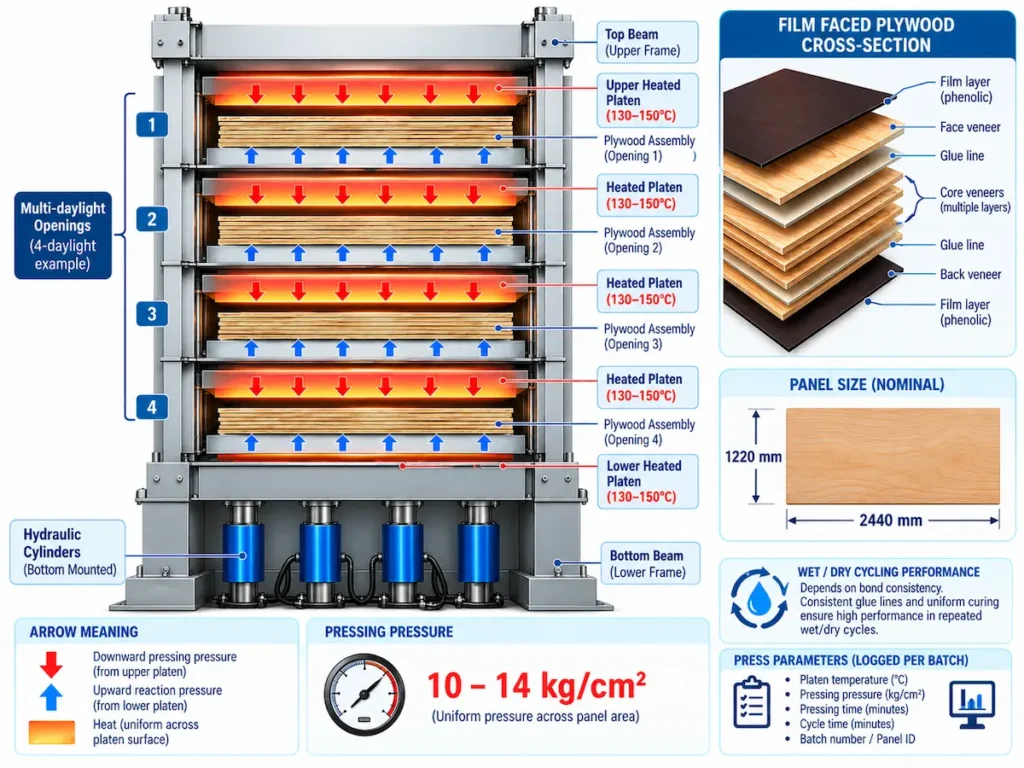
The normal manufacturing sequence includes the following stages.
- Veneer preparation: Veneers are dried, graded, trimmed, and checked for moisture and defects.
- Glue application: The specified adhesive is applied to the required veneer surfaces.
- Lay-up assembly: Veneers are arranged in the correct sequence and grain direction.
- Loading: The assembled mats are inserted into the press openings.
- Press closing: The platens close and apply the programmed pressing force.
- Adhesive curing: Heat transfers through the veneer layers while pressure is maintained for the validated pressing schedule.
- Opening and unloading: The press opens, and the bonded panels are removed.
- Post-press processing: Panels proceed to cooling or conditioning, trimming, sanding, grading, and finishing as required.
3. Main components of a plywood hot press
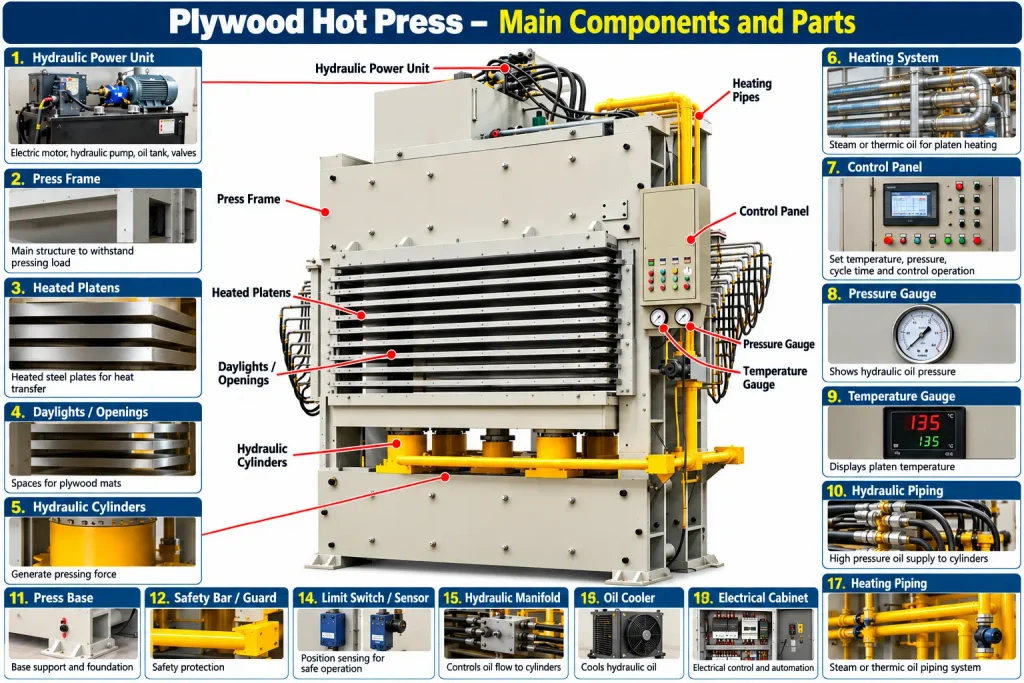
| Component | Main function | Inspection point |
|---|---|---|
| 1. Press frame | Supports the pressing load | Structural condition, cracks and alignment |
| 2. Top beam | Supports the upper press structure | Fasteners and structural condition |
| 3. Bottom beam | Supports the lower press structure | Foundation and alignment |
| 4. Heated platens | Transfer heat to the plywood assembly | Flatness, surface condition and temperature uniformity |
| 5. Daylights/openings | Provide spaces for loading plywood assemblies | Opening clearance and parallelism |
| 6. Hydraulic cylinders | Convert hydraulic pressure into pressing force | Leakage, seals and movement |
| 7. Hydraulic power pack | Supplies hydraulic oil flow and pressure | Oil level, filters, pump and temperature |
| 8. Hydraulic valves | Control pressure, flow and movement | Leakage, response and pressure stability |
| 9. Hydraulic pipelines | Carry oil between the power pack and cylinders | Leakage, hose condition and connections |
| 10. Heating system | Supplies heat to the platens | Flow, leaks and temperature stability |
| 11. Temperature sensors | Measure process temperature | Calibration and reading accuracy |
| 12. Pressure instrumentation | Monitors hydraulic or pressing parameters | Calibration and consistency |
| 13. Control panel/PLC | Controls sequences and operating settings | Alarms, interlocks and cycle records |
| 14. Loading/unloading table | Supports material handling | Roller movement and alignment |
| 15. Safety devices | Protect operators from hazardous movement | Emergency stops, guards and interlocks |
How to choose the right daylight capacity
Do not select a press only by the number of openings. Compare:
- Required production per shift and per day.
- Actual pressing cycle for each plywood thickness.
- Time required for loading, closing, opening, and unloading.
- Required platen temperature uniformity.
- Hydraulic capacity and pressing force.
- Available manpower and material-handling equipment.
- Floor space, maintenance access, energy consumption, and capital cost.
5. Plywood hot press temperature
Pressing temperature determines how quickly heat reaches the adhesive lines and how the adhesive cures.
For illustration, some plywood manufacturing processes operate at platen temperatures around 120–150°C. This is not a universal recommendation: the correct value must follow the adhesive supplier’s instructions and the validated production recipe.
The required setting depends on:
- Adhesive type and formulation, including UF, MUF or PF systems.
- Plywood thickness and veneer species.
- Veneer moisture content.
- Glue spread and assembly time.
- Heat transfer through the veneer layers.
- Required bond performance and applicable product specification.
Problems caused by unsuitable temperature
- Too low: slow or incomplete adhesive curing.
- Too high: premature curing, excessive steam generation, or other quality defects.
- Uneven temperature: inconsistent curing between press locations.
Always verify the actual platen temperature at representative locations and investigate cold spots before changing the production recipe.
6. Plywood hot press pressure
Pressing pressure consolidates the veneer assembly and helps maintain close contact between the glued surfaces.
The required pressure depends on wood species, veneer thickness, panel thickness, adhesive characteristics, and the machine’s design.
Hydraulic pressure versus panel pressure
Hydraulic oil pressure and pressure applied to the plywood surface are not the same measurement.
Hydraulic Pressure vs. Panel Pressure
Hydraulic oil pressure and the pressure applied to the plywood surface are not the same measurement.
1. Hydraulic Force
F = Hydraulic force (N)
Ph = Hydraulic oil pressure (N/m²)
Ac = Total effective cylinder piston area (m²)
2. Average Panel Pressure
Ppanel = Average pressure on the loaded panel area
Feffective = Effective pressing force (N)
Aloaded = Total loaded panel area (m²)
Effect of Incorrect Pressing Pressure
- Too little pressure: Poor contact between veneer layers and potentially weak bonding.
- Excessive pressure: Excessive veneer compression, reduced panel thickness, or damage to the assembly.
Use consistent units and account for cylinder arrangement, mechanical losses, and the effective area actually loaded. Follow the machine manufacturer’s rated force and operating limits.
Too little pressure may result in poor contact and weak bonding. Excessive pressure can compress the veneer excessively, reduce panel thickness, or damage the assembly.
7. Plywood hot press pressing time and cycle time
These terms should be recorded separately.
- Pressing time: Time for which the panel remains under the prescribed pressing conditions.
- Cycle time: Total time needed to complete a production cycle, including relevant handling and press movements.
For example, a hypothetical cycle could include:
| Activity | Time |
|---|---|
| Loading | 60 seconds |
| Closing and pressure build-up | 20 seconds |
| Pressing dwell | 900 seconds |
| Opening | 20 seconds |
| Unloading | 80 seconds |
| Total cycle time | 1,080 seconds (18 minutes) |
This is only an arithmetic example, not a recommended production schedule.
The required pressing time depends on plywood thickness, adhesive curing requirements, veneer moisture, platen temperature, heat transfer, and the validated recipe. A longer cycle can reduce output even when the press has more daylights.
8. How to calculate plywood hot press production capacity
Hot Press Production Capacity
Compare 10, 15, 20 and 30 daylight presses with production labels.
Estimated Production per Hour
Production quantity is shown above each bar. Default chart remains visible even if WordPress blocks scripts.
⚙ Operating Parameters
Production Comparison
Theoretical and estimated hourly output.
| Press | Cycle | Theory/hr | Estimated/hr |
|---|---|---|---|
| 10 DL | 5 min | 120 | 108 |
| 15 DL | 5 min | 180 | 162 |
| 20 DL | 5 min | 240 | 216 |
| 30 DL | 5 min | 360 | 324 |
Assumes one board per daylight, 5-minute cycle and 90% operating efficiency. Actual output varies with product thickness, handling time, downtime and loading efficiency.
9. Common plywood hot press defects and troubleshooting
| Defect | Possible cause | Recommended check |
|---|---|---|
| Delamination | Inadequate bonding or incomplete curing | Glue spread, adhesive condition, pressing recipe |
| Blows or blisters | Trapped moisture or steam-related issues | Veneer moisture, lay-up condition and pressing schedule |
| Uneven thickness | Platen alignment or inconsistent loading | Platen parallelism, mat thickness and pressure distribution |
| Excessive thickness reduction | Excessive compression or incorrect settings | Press force, thickness stops and loading consistency |
| Weak bonding | Insufficient curing or unsuitable adhesive | Adhesive preparation, temperature and dwell time |
| Surface marks | Dirty or damaged platen surface | Platen cleanliness and surface condition |
| Uneven curing | Uneven heat distribution | Platen temperature measurements and heating circuit |
Troubleshooting should use production records, bond-quality tests, inspection results, and controlled trials. Avoid changing several process parameters simultaneously because this makes the root cause difficult to identify.
10. Preventive maintenance of a plywood hot press
A preventive maintenance schedule should cover the following areas.
Inspect hydraulic hoses, seals, cylinders and connections for leakage.
Check hydraulic oil level, condition, filters and temperature.
Inspect the heating circuit and investigate temperature variations.
Verify temperature sensors and pressure instrumentation.
Check platen flatness, alignment and parallelism according to manufacturer limits.
Inspect the press frame, beams, fasteners and foundation.
Test emergency stops, guards and safety interlocks.
Record cycle time, downtime, breakdowns, and production output.
Clean platen surfaces using approved procedures.
Follow the manufacturer’s lubrication and scheduled-maintenance instructions.
Maintenance must be performed by trained personnel under approved isolation and lockout procedures. Never enter the press danger zone while the equipment can move.
11. Safety precautions
A plywood hot press combines high temperatures, heavy moving platens, hydraulic pressure, and substantial mechanical forces.
- Never bypass safety interlocks.
- Keep hands and tools away from closing platens.
- Use the machine’s approved guarding and loading system.
- Isolate and secure the equipment before maintenance.
- Check emergency stops and protective devices regularly.
- Follow approved procedures for hydraulic and thermal-system maintenance.
- Ensure operators are trained on the specific machine and its emergency procedures.
12. Best practices to improve hot press performance
- Standardize pressing recipes by product thickness and adhesive system.
- Monitor actual platen temperature, not just the control-panel setpoint.
- Maintain consistent veneer moisture and lay-up quality.
- Record pressing time separately from total cycle time.
- Monitor production per cycle, actual output per hour, and rejection rate.
- Investigate repeated blows and delamination using root-cause analysis.
- Compare presses under equivalent operating conditions.
- Track downtime and preventive maintenance compliance.
- Ensure loading and unloading capacity matches the press cycle.
- Validate all changes through quality testing before making them standard practice.
Frequently asked questions
What is the function of a plywood hot press?
It applies controlled heat and pressure to cure adhesive between veneer layers and produce a bonded plywood panel.
What is the ideal temperature for plywood hot pressing?
There is no single ideal temperature for every plywood product. The setting depends on the adhesive, veneer moisture, panel thickness, and validated pressing recipe.
What is the difference between 15, 20 and 30 daylight hot presses?
They differ in the number of working openings. More openings can increase theoretical output per cycle, provided the cycle time, loading, heating, and hydraulic system support the production requirement.
Does a 30-daylight press always produce more than a 20-daylight press?
Not necessarily in actual production. At the same cycle time and loading conditions, the 30-daylight press has greater theoretical capacity. However, a longer cycle, frequent downtime, incomplete loading, or material-handling constraints can reduce its advantage.
How is hot press production calculated?
Multiply the number of daylights by 60 and divide by cycle time in minutes. Apply a realistic operating-efficiency factor to estimate actual production.
What causes delamination in plywood?
Potential causes include inadequate glue coverage, unsuitable adhesive preparation, incomplete curing, contaminated veneer surfaces, and incorrect pressing conditions.
Why is platen temperature uniformity important?
Uneven heating can cause different adhesive curing conditions across the press, potentially resulting in inconsistent bond quality.